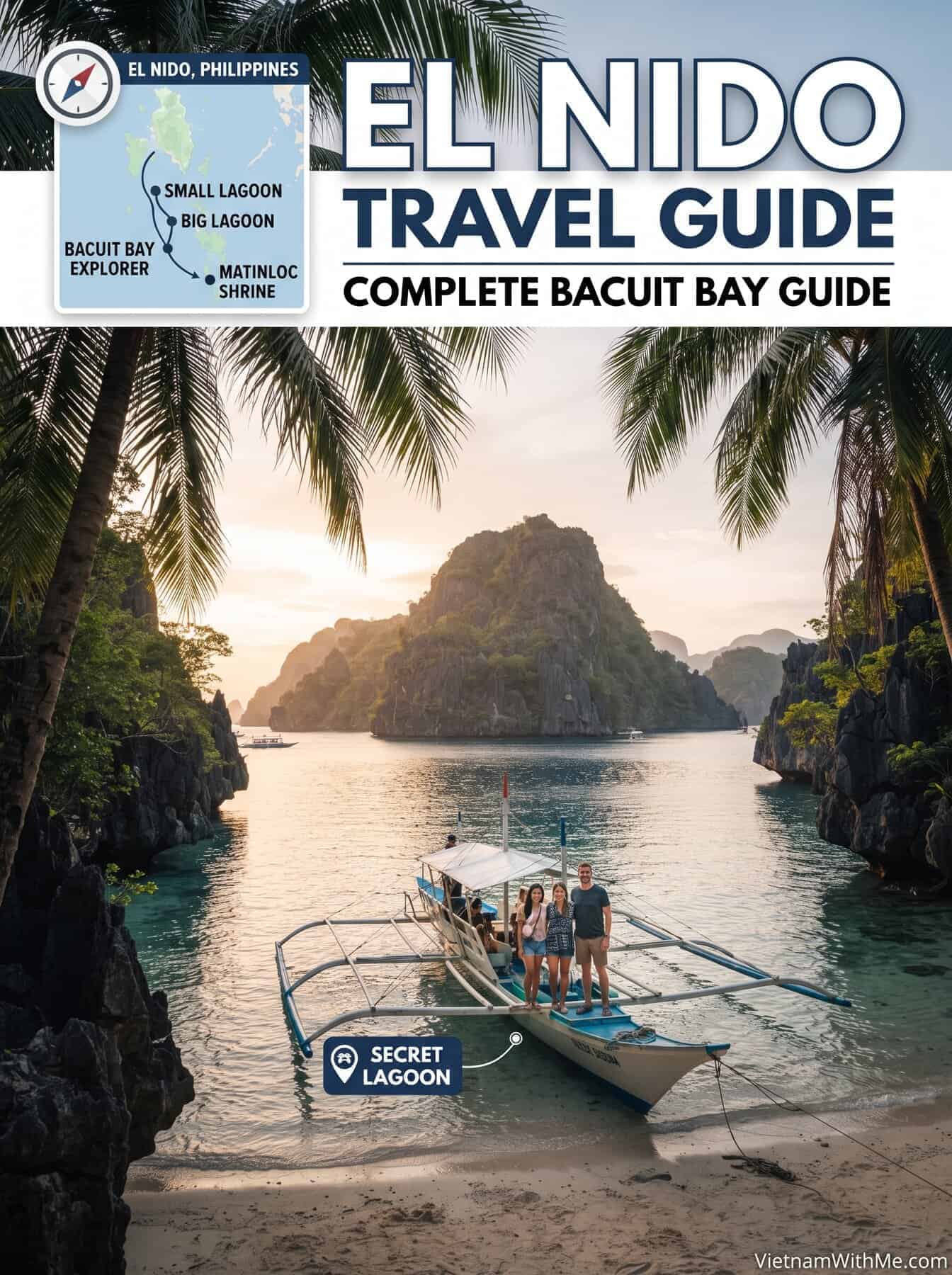
This El Nido travel guide covers everything you need to plan a trip to the limestone-studded northern tip of Palawan: how the island-hopping tours work, which beaches are worth a day, what to do on land, how to get here, and how many days to allow. El Nido sits on Bacuit Bay, a seascape of cliffs, lagoons and small beaches that makes it one of the most photographed places in the country, and it rewards a bit of planning. It also sits within the wider Palawan region, so if you are building a longer route, our guide to getting from Manila to Palawan by flight or ferry is a good place to start. Below we stick to details that multiple sources agree on, and we point you to official channels for anything that changes, such as fees and schedules.
Why Our El Nido Travel Guide Starts With Bacuit Bay
El Nido is a small town with a big backdrop. Sheer karst cliffs rise straight out of turquoise water, and Bacuit Bay scatters dozens of islands, hidden lagoons and pale beaches across the horizon. Most visitors come for boat days, but the area also has long stretches of sand, jungle waterfalls, a steep viewpoint hike, diving and a lively waterfront with seafood grills. The trade-off is that it is a popular place. Lagoons can be busy in the middle of the day, ATMs are limited, and sea conditions control your plans. Go in with a flexible schedule and you will have a great time.
Bacuit Bay and Island-Hopping Tours A, B, C and D
Island hopping is the main event. Operators in town sell four standard routes labelled A to D, each visiting a different cluster of islands, lagoons and beaches over a full day, typically leaving around 9 a.m. and returning around 4 p.m. Shared (joiner) tours cost roughly PHP 1,200 to 1,800 per person depending on the route and operator, with Tour C and Tour B at the upper end and Tours A and D at the lower end, before any fees. Stops can vary slightly by operator and sea conditions, so treat the lists below as the typical itinerary rather than a promise.
Tour A: Lagoons and Shimizu Island
Tour A is the classic. It usually combines the Big Lagoon, the Secret Lagoon, Payong-Payong Beach, Shimizu Island and 7 Commandos Beach. It is the best choice if you only have one day and want the signature lagoon scenery. Expect company, because it is the most popular route.
Tour B: Snake Island, Entalula and Caves
Tour B typically takes in Snake Island, Pinagbuyutan Island, Entalula Island, Cathedral Cave and Cudugnon Cave. It suits travellers who like sandbars, beach time and caves rather than lagoon kayaking.
Tour C: Hidden Beach and Matinloc Shrine
Tour C usually visits Helicopter Island, Matinloc Shrine, Hidden Beach, Secret Beach and Talisay Beach. It is a favorite for the enclosed beaches, which you reach through narrow openings in the rock, and a good second tour after A.
Tour D: Cadlao, Small Lagoon and Paradise Beach
Tour D commonly includes the Small Lagoon, Paradise Beach, Cadlao Lagoon, Pasandigan Beach and Bukal Beach. It is often quieter and has good snorkeling and kayaking, which makes it a relaxed option for a slower day.
Tours A to D Side by Side
Every route needs the PHP 400 environmental fee once per 10 days. The lagoon and shrine fees below are charged per person at the stop, and snorkel and towel rentals are optional on all four.
| Tour | Main stops | Paid on top of the boat fare | Crowds and sea |
|---|---|---|---|
| A | Big Lagoon, Secret Lagoon, Shimizu Island, Payong-Payong, 7 Commandos | Big Lagoon fee PHP 200; kayak rental | Busiest route; the most weather-resistant of the four |
| B | Snake Island, Entalula, Cudugnon Cave, Cathedral Cave | No lagoon fee | Generally quieter than A and C |
| C | Hidden Beach, Secret Beach, Matinloc Shrine, Talisay, Helicopter Island | Matinloc Shrine PHP 200 (optional) | Popular, more open water, the first to be canceled in rough seas |
| D | Small Lagoon, Cadlao Lagoon, Paradise Beach, Pasandigan | Small Lagoon fee PHP 200; kayak rental | Usually quieter than A |
What Tours Usually Include
Typical inclusions are the boat and boat permit, a licensed guide, life vests, a picnic-style lunch and usually snorkeling gear. Kayaks are normally a separate rental of about PHP 250 to 400, paid at the lagoon. Many listed prices leave out the environmental fee and lagoon fees, so ask exactly what is covered before you pay. Shared tours are cheaper. A private outrigger boat for two people runs around PHP 13,000 to 14,000 depending on the route, plus roughly PHP 1,200 to 1,400 for each extra person, and a private speedboat costs about PHP 19,500 to 20,000 for two. Private boats let you set the pace and often start early to beat the crowds.
Pickup from your hotel in town or at Corong-Corong is usually part of the price, and boats are back between 4 and 5 p.m. A tip for the boat crew is customary and is not included.
Fees and Rules
The environmental fee is PHP 400 per person and is valid for 10 days, collected by the municipal tourism office or an accredited operator, with separate lagoon fees of around PHP 200 for the Big Lagoon and Small Lagoon. Keep your receipt, because it covers every tour during those 10 days. The Big Lagoon admits only a limited number of visitors per time slot, so book your tour a day ahead rather than on the morning you want to go. Rules reported for Bacuit Bay include wearing life jackets, no loud music, no cliff jumping in the lagoons, no grilling, no littering food in the water, no stepping on or taking coral, and no smoking or alcohol on tours. Amounts and regulations are updated by local authorities, so confirm them with your operator and the official Philippine Department of Tourism channels before you go.
If the Sea Is Rough
Boats stay in port when the Coast Guard issues a gale warning, and operators also cancel when the bay is too rough without one. Tour C is usually the first to go because it leaves the sheltered bay, and Tour A is the most likely to run. Cancellations are most common from July to October, so keep a spare day in your plan and ask the operator before you pay whether a canceled tour moves to the next day or is refunded. On a lost boat day, the land options are Nacpan and Las Cabañas beaches, the Nagkalit-kalit waterfall and a cooking class. Diving depends on the sea too, so do not count on it as a backup.
El Nido Beaches
Nacpan Beach
Nacpan stretches for roughly four kilometers and joins neighboring Calitang to form the so-called Twin Beaches. It is about 45 minutes north of town by road, with a wide shoreline and a relaxed atmosphere. Swimming, kayaking and sunset watching are the main activities. There is no ATM here and mobile signal can be unreliable, so bring enough cash.
Duli Beach
Duli is a worthwhile side trip from Nacpan and sits close to the beach hostels in that area. It is a good choice if you want to avoid town and spend a night near the sand.
Las Cabañas (Marimegmeg) Beach
Marimegmeg Beach is better known as Las Cabañas after the resort located there. It is popular for sunset and has a zipline ride to a nearby island. It is closer to town than Nacpan, so it works as a half-day plan.
Corong-Corong Beach
Corong-Corong is about 1.1 kilometers from central El Nido. It is a working beach used by fishing and tour boats, and it is also where vans from Puerto Princesa arrive at the transport terminal. Many travelers stay here for a quieter base with views across the bay. If you are weighing where to sleep, see our picks for the best resorts in El Nido.
Lagoons: Big, Small, Secret and Cadlao
The lagoons are the reason many people book the tours. The Big Lagoon and Small Lagoon appear on Tours A and D respectively, each with a separate environmental user fee. The Secret Lagoon, reached through a small opening in the rock, is also on Tour A, and Cadlao Lagoon is on Tour D. Kayaks are rented separately at the lagoon for about PHP 250 to 400, and paddling is optional. Go early in the day if you can, because the Big Lagoon limits visitor and kayak numbers per time slot to protect it.
Things to Do Beyond Island Hopping
- Taraw Peak: At about 230 meters, it is the highest point overlooking the town and bay. The climb is short but steep, and access is now regulated with a guide, a helmet and an entrance fee of about PHP 400. The rock is sharp, so go only with a guide recognized by the municipal tourism office.
- Nagkalit-kalit Waterfall: A hike of roughly 30 to 40 minutes on the road toward Nacpan, with river crossings, so expect wet feet.
- Diving: Bacuit Bay has more than 30 dive sites with coral gardens, walls and tunnels. South Miniloc is known for turtles and schooling jacks, and Dilumacad Tunnel is for more advanced divers. October to May is described as the clearer, calmer season.
- Kayaking: Rent a kayak to explore around Cadlao Island at your own pace.
- Cooking classes: Offered in home or boutique kitchens, usually starting at the market.
El Nido Town and Food
The town is compact and walkable, with a beachfront strip, a market and plenty of places to eat. Seafood grilled on the waterfront is the obvious choice, alongside Filipino staples such as adobo, sinigang and kinilaw, the local take on ceviche. The market is a good place to see local produce. For wider context on what to order across the country, see our Philippine food guide. Bring cash for smaller eateries, and keep in mind that some places may not accept cards.
Getting to El Nido and Getting Around
By Air
El Nido (Lio) Airport receives flights from several cities. The flights are operated by Cebgo (flight code DG), which took over the former AirSWIFT services on July 1, 2026. Since March 29, 2026, flights from the Manila area leave from Clark International Airport, about 80 kilometers northwest of the capital, and not from NAIA, so allow extra time and money to get from Manila to Clark. The Clark flight takes about 1.5 hours, and El Nido is also linked with Cebu, Caticlan and Coron. Lio Airport is about 4 kilometers north of town, a 15- to 20-minute tricycle ride, and many hotels send a transfer. For a full breakdown of all options from the capital, read our Manila to Palawan guide.
By Road from Puerto Princesa
Shared vans run between Puerto Princesa and El Nido, with reported journey times of roughly four to six hours depending on traffic and stops, and private transfers take around five hours. Vans usually drop passengers at the El Nido transport terminal in Corong-Corong, from where a tricycle takes you into town. If you are visiting the Underground River too, read our Puerto Princesa Underground River guide and plan that stop around your van ride.
To and From Coron
Many travelers combine El Nido with Coron. Our guide to getting from El Nido to Coron explains the options, and if you are deciding between the two, see El Nido vs Coron. You can also read about Coron on its own.
Getting Around
In town, you can walk or take a tricycle. For Nacpan, Las Cabañas and the waterfall, you will need a tricycle or motorbike and some patience with road conditions. Nacpan is about 17 kilometers from town and has no entrance fee. On a tricycle, agree on the fare, whether it is per vehicle or per person, and how long the driver waits before you leave. The roads to Nacpan and Duli can be rough, gravelly or steep, which matters on a motorbike after rain. Las Cabañas is about 20 minutes south of town by tricycle and free to enter. Boat tours handle the bay itself.
Best Time to Visit
El Nido has a dry season from November to May and a wetter season from June to October. The dry months bring the best conditions for island hopping and snorkeling, with February and March often described as the driest. December is reported as the busiest month with accommodation filling fast, so January to March can be a calmer pick with equally good weather. In the rainy season, rougher seas can cancel boat tours, though crowds and prices tend to drop. For a country-wide view, see our best time to visit the Philippines, and check forecasts from PAGASA.
Costs, Cash and ATMs
El Nido is not the cheapest place in the Philippines. Costs are moderate to high compared with smaller towns, driven by boat tours, fees and accommodation in peak season. Hostels and simple rooms keep budgets low, while resorts push them far higher. Prices vary by season, so check current rates rather than relying on old figures. Cash caution: ATM access in town is limited and machines sometimes run out of cash in busy periods, so withdraw enough in Puerto Princesa before you travel. There is no ATM at Nacpan Beach. Carry small bills for tricycles, fees and beach eateries. Our Philippines money guide covers cards and currency in more detail.
How Many Days to Spend
Three days is the commonly recommended minimum. Because each island-hopping tour is a full day, three days allows two tours plus time for a land beach or hike. If you want all four tours, add two days, and consider extra buffer for weather. Combining El Nido with Coron or the Underground River makes a good Palawan loop; the Palawan 5-day itinerary shows one way to do it.
Frequently Asked Questions
How many days do I need in El Nido?
Three days is the commonly recommended minimum. That gives you two full island-hopping days plus a day for a land-side beach such as Nacpan or a hike. If you want to try all four tours, add a day or two for weather buffer.
Which island-hopping tour is best for first-timers?
Tour A is the usual first pick because it combines the Big Lagoon, the Secret Lagoon, Shimizu Island and 7 Commandos Beach. Tour C is a strong second for Hidden Beach and Matinloc Shrine.
Is there an ATM in El Nido?
There are some, but access is limited and machines can run out of cash in busy periods. Withdraw enough in Puerto Princesa before the trip and carry cash for beaches such as Nacpan, which has no ATM.
What is the best time to visit El Nido?
The dry season, roughly November to May, is the best for boat tours and snorkeling. June to October is wetter and rougher at sea, though it is quieter and often cheaper.
Do I need to pay an environmental fee?
Yes. The environmental fee is PHP 400 per person and is valid for 10 days. You pay it at the municipal tourism office or through an accredited operator, and the Big Lagoon and Small Lagoon charge a separate PHP 200 each.
Can I fly directly to El Nido?
Yes. Cebgo, which took over the former AirSWIFT flights, serves El Nido (Lio) Airport from Clark, Cebu, Caticlan and Coron. Flights from the Manila area now leave from Clark rather than NAIA.
Bottom Line
El Nido rewards anyone who gives it three or more days, travels in the dry season and brings enough cash. Book Tour A for the lagoons, add Tour C or D for variety, save a day for Nacpan, and confirm fees and rules locally before you go.