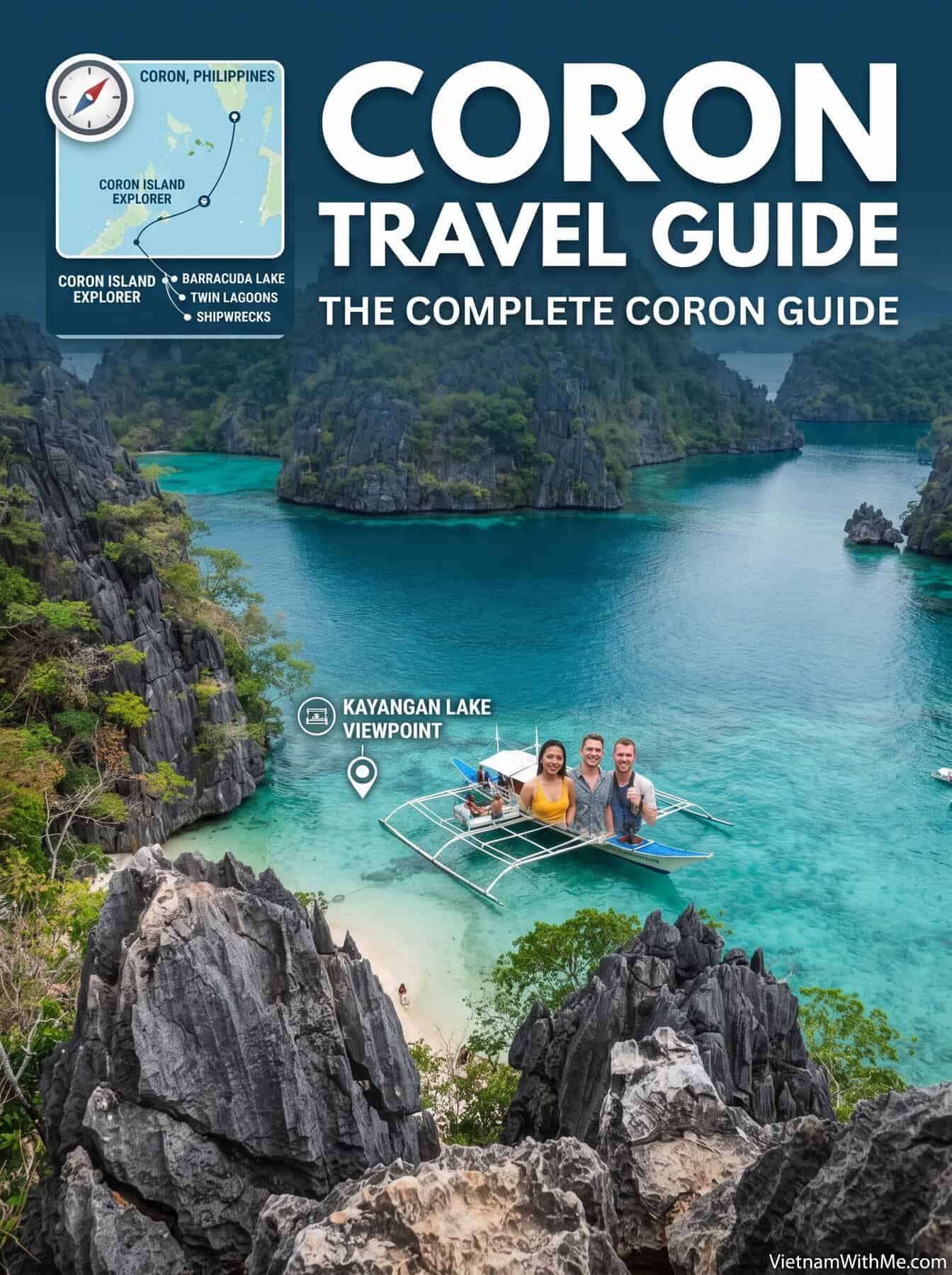
This Coron travel guide covers everything a first-time visitor needs to plan a trip to the Calamian Islands in northern Palawan: where Coron town sits on Busuanga Island, which island-hopping stops are worth your day, how the World War II wrecks make this one of the great wreck-diving areas of the world, and how to fit in a hot spring soak and a sunset climb. It is built for planning, so expect practical judgment calls rather than a list of superlatives. Where prices, fees and rules change often, we point you to current sources instead of quoting numbers that may be stale.
Coron Travel Guide at a Glance: Town, Island and Airport
Coron is both a municipality and the name of the main town, which lies on Busuanga Island. The limestone island you see in photographs is Coron Island, a separate island just offshore, and most of the famous lakes and lagoons belong to it. Busuanga Airport is the only airport serving the area, and it sits roughly 30 to 45 minutes by road from Coron town proper. Coron town itself is compact, a little rough around the edges, and built around the waterfront, the public market and the piers where tour boats leave each morning. Think of town as a base, not a destination. Most visitors spend their days on boats or underwater and return in the evening for dinner, a soak and a sunset viewpoint. If you want a quieter stay on the water rather than in town, the options are covered in our guide to the best hotels in Coron, which breaks down areas and budget tiers.
Island Hopping: The Reason Most People Come
Island hopping is the main attraction in Coron, and it’s the centerpiece of this Coron travel guide. Operators sell their trips as lettered tours, commonly called Tour A, B, C and so on, and the stops vary slightly between companies, so always ask for the exact itinerary before you pay. Boats range from shared outrigger bancas to larger party boats that carry up to around 20 people, and private charters are also common.
A full-day tour runs about 8 to 9 hours, with hotel pickups from around 7:30 a.m.
Kayangan Lake
Kayangan Lake is the postcard stop, often described as one of the cleanest lakes in Asia, with clear emerald water below limestone cliffs. It is usually included in the all-round route known as Tour A. Popular stops get busy by mid-morning, so ask whether your operator visits early or late in the day.
Twin Lagoon
Twin Lagoon is reached by swimming or kayaking through a small gap between cliffs, and the draw is the contrast between the two bodies of water, with different tones of green and blue. It is a short, atmospheric stop rather than a place to spend hours.
Barracuda Lake
Barracuda Lake is famous for its thermocline, the abrupt temperature change where layers of fresh, brackish and salt water meet. It is a favorite with divers and also a standard snorkel stop on Tour B. Expect an unusual sensation as you move from cooler to noticeably warmer water.
Banol Beach and CYC Beach
Banol Beach is known for soft white sand and clear water, and it appears on Tour B. CYC Beach is a lunch and swim stop that features in Tour A. Both are the relaxed counterpoint to the lakes, and they are where most tours break for lunch.
Skeleton Wreck and the beach tours
The Skeleton Wreck is a World War II era Japanese supply ship resting in shallow water, so snorkelers can see it without any dive training. Tour C leans toward beaches, including Malcapuya and a sandbar, and suits anyone who wants a slower day after the lakes. Other lettered tours exist, so compare operator itineraries directly.
How to choose
- One day: Tour A is the usual all-round choice, covering the lakes, a coral garden snorkel and a beach.
- Two or three days: add Tour B for the wreck and Barracuda Lake, and Tour C for beaches.
- Private boat: useful for starting early to beat the crowds or for customizing stops, usually at a higher price.
Entrance and environmental fees are collected at many stops and can change, and operators may or may not include them in the quoted price. Ask exactly what is included and keep small cash with you for any extras. Joiner (shared) day tours usually cost around PHP 1,500 to 2,000 per person, and lake entrance fees are often charged on top: roughly PHP 300 for Kayangan Lake, PHP 250 for Barracuda Lake and PHP 200 for Twin Lagoon. On top of that, every visitor to Coron, children and infants included, needs an individual QR code from the municipality’s Coron iPASS registration site, where you enter your arrival date, hotel and how you are arriving and pay the environmental tourism development fee online. Refunds are not available, but the QR code stays valid for the calendar year of the arrival date you entered, so a delayed trip within that year does not cost you the fee.
WWII Wreck Diving in Coron Bay
On 24 September 1944, a US carrier air raid hit a Japanese supply convoy sheltering in Coron Bay. Within roughly 40 minutes a fleet of ships was burning or sinking, and the wrecks that settled on the seabed are now the draw for divers. One account says around 24 Japanese naval ships are thought to lie off Busuanga, of which only 11 have been found. Names you will hear in dive shops include the Akitsushima, a seaplane tender of about 118 metres, and the Olympia Maru, a freighter of about 122 metres. The Okikawa Maru, Kogyo Maru, Irako and Kyokuzan Maru also feature in the history of the raid. Many wrecks lie at moderate depth, and the shallowest, such as the Skeleton Wreck, can be seen by snorkelers. Deeper wrecks and penetration dives need appropriate certification, so check the experience and safety standards of any operator. For the history and dive detail, the Dive Magazine feature on the wrecks of Coron Bay and the ScubaTech Philippines guide to the Coron wrecks are good starting points for the diving side of this Coron travel guide. These sites are war graves as well as dive sites. Dive respectfully, do not remove anything and follow your guide on penetration rules.
Maquinit Hot Springs
Maquinit Hot Springs is a saltwater hot spring with three pools at roughly 38 to 40 degrees Celsius, set among mangroves. It is reported to be the only known saltwater hot spring in the Philippines. Facilities are simple, with bathrooms, tables and palm huts, and there is a short boardwalk through the mangroves. The springs are about 5 kilometers south of town, roughly 20 minutes by tricycle, and there is no public transport, so you reach them by tricycle, with a tour or with a private driver. It is a popular evening activity, a good recovery soak after a day on the boat. Entry is charged per person, last entry is at 7 p.m. and the springs close at 8 p.m. Because the water is hot, it feels best in the cooler evening rather than at midday.
Mount Tapyas Viewpoint
Mount Tapyas is the easiest big view in Coron town. The summit has a platform, a tall cross and the big CORON letters, with views over the town, the bay and Coron Island. The climb is 721 steep steps, and although the peak is only about 210 metres above sea level, the heat makes it a workout. Entry has been reported as free, and a tricycle from town to the trailhead is cheap. Start about an hour before sunset so you have time to climb and enjoy the light, and carry water and a small torch for the descent. Pair it with Maquinit on a single evening, or do it on a rest day between boat tours.
Calauit Safari Park
If you want a wildlife day, Calauit lies on a separate island at the northwest tip of Busuanga. African animals were brought here from Kenya in 1976, and the park today shelters free-roaming giraffes and zebras, plus the native Calamian deer. Reports mention around 25 giraffes and 35 zebras, but numbers change, so treat those as a rough guide. Calauit is a long day trip. It is around 80 km from Coron town, a drive of two to three hours each way, followed by a short boat crossing of about 10 minutes. Many people book a land tour rather than arrange it themselves. Ask whether it will be a full day and what feeding hours apply, since one source says giraffe feeding is in the morning. Animal welfare is debated for parks of this kind, so research an operator that follows sensible rules about feeding and distance.
Coron Travel Guide to Getting There and Around
See our best hotels in Coron guide for where to stay, and check flights and ferries from Manila to Palawan if you are starting your trip in Manila. The fastest way is to fly into Busuanga Airport. Since March 29, 2026, Cebgo, the regional carrier of Cebu Pacific, has flown to Busuanga from Clark rather than Manila’s NAIA airport, and Sunlight Air also flies from Clark, so allow extra time to reach Clark, about 80 kilometers northwest of the capital. There are also direct flights from Cebu. Schedules change, so check airline timetables. For a full overview of routes from the capital, see Manila to Palawan flights and ferries, and if you are also considering Palawan’s other hub, our El Nido guide shows how the two compare as a base. The alternative is to fly to Puerto Princesa and take a ferry to Coron, but this is a long trip of about 13 hours, not a short hop. The 2GO sailing listed on its schedule leaves Puerto Princesa on Sunday at 4:30 a.m. and reaches Coron at 5:30 p.m., and the return leaves Coron on Saturday at 9:30 a.m. Most visitors fly into Busuanga instead. Ferry operator 2GO Travel publishes information on its Coron destination, though routes and schedules change. If you are combining Palawan stops, the guide on getting from El Nido to Coron covers that connection.
Travel Times to Coron at a Glance
| Route | How | Time | Good to know |
|---|---|---|---|
| Clark to Busuanga | Cebgo, Sunlight Air | About 1 hour 5 minutes to 1 hour 25 minutes | Cebgo flies it 16 times a week |
| Cebu to Busuanga | Philippine Airlines, Cebgo | About 1 hour 20 minutes to 1 hour 40 minutes | Morning departures are available |
| El Nido to Busuanga | Cebgo | About 40 minutes | Faster than the boat, but fewer departures |
| El Nido to Coron | Fast ferry | About 3.5 to 4 hours | Sailings depend on the sea |
| Manila to Coron | 2GO overnight ferry | About 13 hours | Leaves Friday at 5:30 p.m., arrives Saturday at 6:30 a.m. |
| Busuanga Airport to Coron town | Shared van | 30 to 45 minutes | Leaves when full |
From the airport to town
Shared shuttles run from outside the airport and leave when they fill, and private transfers can be booked in advance. Allow 30 to 45 minutes for the drive.
Getting around
Tricycles are the standard way to move around town and to places such as Maquinit and the Mount Tapyas trailhead. Agree on the fare before you get in. For day trips, most visitors join tours or hire a driver or motorbike rather than rely on public transport.
Best Time to Visit Coron
The dry season runs roughly from November to May, with December to March the most popular and February and March reported as the driest. April and May bring fewer crowds but high temperatures, and November is a shoulder month. The wetter months, roughly June to October, bring higher chances of typhoons and heavy rain, and rough seas can disrupt boat trips and dives. Our guide to the best time to visit the Philippines goes into regional patterns. This Coron travel guide assumes dry-season planning by default, since most of the island-hopping and diving above depends on calm seas. If you travel in the wetter months, build a spare day into your plan and be ready for cancelled tours.
If the Sea Is Rough
Boats do not sail when the Coast Guard issues a gale warning, and operators also cancel when the sea is too rough, which happens most often in the wetter months. Ask the operator to move a canceled tour to the next day, which is why a spare day matters. On a lost boat day, Mount Tapyas and the Maquinit Hot Springs need no boat, and the springs are at their best in the evening, with last entry at 7 p.m. Dives and wreck snorkeling depend on the sea too, so they are not a backup.
How Many Days Do You Need?
Three days is the practical minimum. Do Tour A or B on one day and Tour C on another, then keep an evening for Mount Tapyas and Maquinit. Divers should add at least two or three extra days for wrecks, and anyone adding Calauit should add a full day. A relaxed trip with a rest day suits four to five days. Use the day counts above as this Coron travel guide’s starting point, then adjust up for diving or Calauit. If you are weighing Coron against its neighbor, our comparison of El Nido vs Coron can help you decide how to split your time.
Where to Eat
Coron food centers on fresh seafood and Filipino comfort dishes. Grilled fish, kinilaw (a Filipino ceviche) and lato seaweed salad appear on many menus. The Coron Public Market is a good place to see the fresh catch and try street food. Sit-down options mentioned by travelers include La Sirenetta by the Sea for sunset views, Kawayan Grill for Filipino classics and Trattoria Altrove for Italian. Roasted cashew nuts are a popular souvenir. Boat tours usually include a simple grilled lunch, so ask what is on the menu if you have dietary needs.
What Does Coron Cost?
Coron is generally a mid-range destination by Philippine standards: cheap eating and tricycles, but tours and diving make up most of the budget. Budget travelers can stay in hostels and join shared tours. Mid-range travelers can use private rooms and mix tours with a private boat day. Divers and private-charter travelers should plan higher. Quoted tour prices vary and operators handle entrance fees differently, so compare what is included before booking. For general money tips, see our guide to money in the Philippines, and carry cash because card acceptance can be patchy outside town.
Frequently Asked Questions
Quick answers to the questions this Coron travel guide gets asked most often.
How many days are enough for Coron?
Three days covers the main island-hopping tours plus Mount Tapyas and Maquinit. Divers and wildlife fans will want more.
Which island-hopping tour is best?
Tour A is the usual choice for a first visit as it combines the lakes, a coral garden and a beach. Tour B adds the Skeleton Wreck and Barracuda Lake, while Tour C suits beach lovers. Stops differ between operators, so compare itineraries.
Can I snorkel the WWII wrecks?
Yes, the Skeleton Wreck lies in shallow water and is a standard snorkel stop. Deeper wrecks need scuba certification.
Is Mount Tapyas hard to climb?
It is 721 steps and steep, but short. Go near sunset, bring water and take your time.
Do I need a visa for the Philippines?
Many nationalities can enter visa-free for a limited stay, but rules vary, so check the Philippines visa guide and official sources before you travel. Planning to combine Coron with El Nido? Read our getting from El Nido to Coron guide and our El Nido vs Coron comparison to decide which order makes sense, or see the 10-day Philippines itinerary for a full multi-stop trip.
Bottom Line: Coron Travel Guide Wrap-Up
This Coron travel guide’s bottom line is simple: Coron rewards a base of three to five days, with a mix of island-hopping, one wreck snorkel or dive, and an evening at Maquinit and Mount Tapyas. Go in the dry season if you can, book tours with a clear itinerary, and confirm fees and schedules before you travel.