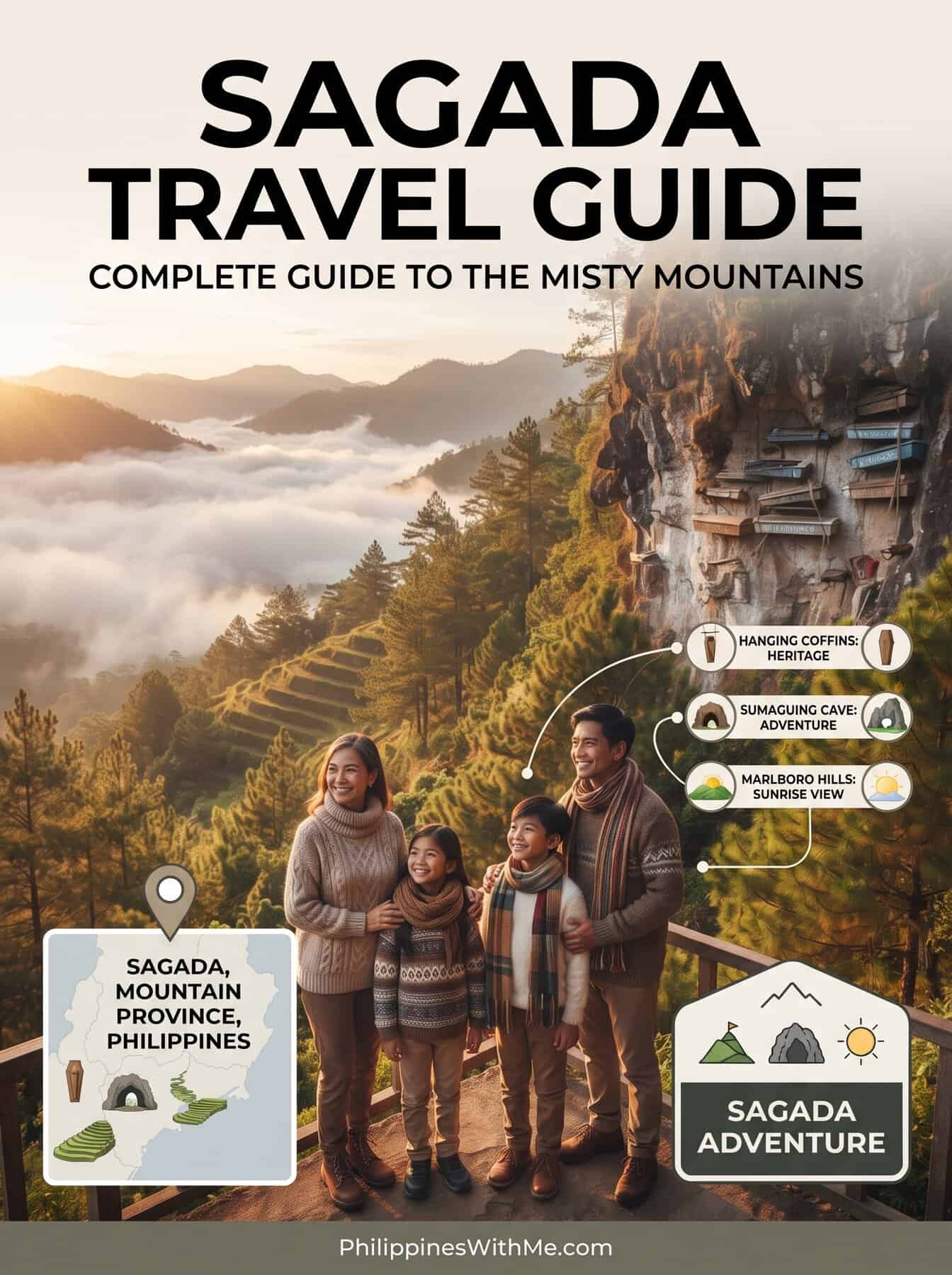
Perched in the Cordillera of Mountain Province, Sagada is the Philippines at its coolest in every sense: pine-scented air, limestone caves, hanging coffins, rice terraces and a small, conservative town that takes its customs seriously. This Sagada travel guide covers what to see, the rules you must follow, how to get there from Baguio and Manila, when to go and how many days to plan. It is written for first-timers who want a realistic picture rather than a highlight reel.
Why Visit Sagada: A Travel Guide Overview
Sagada is not a beach destination, and that is the point. Most people come for a mix of culture and low-key adventure: peering at coffins fixed to a cliff, crawling through caves with a local guide, waking before dawn for a sea of clouds, and then spending slow afternoons over coffee and homemade yogurt. Weather is mild by Philippine standards, the town is walkable, and almost every activity is organized through a central system of registered guides, which makes planning simpler than you might expect. It also pairs well with the rest of northern Luzon. Many travelers combine it with Baguio on the way up, or continue to the rice terraces of Ifugao afterwards. Others fold it into a loop that includes the surf coast of La Union, a very different mood from the mountains.
Sagada Travel Guide Basics: Guides, Registration and Etiquette
For general guidance, see our guide on whether the Philippines is safe and what to pack for the Philippines guide. Understanding the local system before you arrive saves frustration. Sagada manages visitors through a tourist information office in town, and the rules are there to protect both the environment and burial sites.
- Register first. Visitors are required to register at the tourism office, where the registration fee of ₱100 per person and any guide fees are paid. Keep the official receipt, because it serves as your pass to the tourist sites. You can also register online through the municipal tourism website to skip the queue at the office. The online booking produces a QR pass, and paid bookings are non-refundable and non-transferable and no-shows forfeit the payment. After a road closure, flood or typhoon you can request one rebooking within three days of the original date, valid for one year, so register once your dates are fixed. One online booking covers up to five guests, and children aged 7 and below are exempt from registration if you upload proof such as a birth certificate or school ID.
- Use registered guides. Sources describing the town’s visitor rules say only organized tours with registered guides are allowed at the main sites, and that caves have limits on guide-to-visitor ratios and on how many people can be inside at once.
- Expect caps and changes. Sagada has introduced per-site visitor caps and walking-only zones in the past, and it has also closed and reopened key spots. Check the current situation with the tourism office or your lodging before you plan around any single site.
- Do not touch or approach burial sites. The coffins are part of living tradition, not props. Tourists are asked to keep their distance and follow their guide.
- Dress and behave modestly. Sagada is a small, conservative community. Save revealing clothing for the beach and keep public displays of affection low-key.
- Leave no trace. Carry out your trash, follow parking rules and respect rituals if you come across one.
Fees change, so rather than relying on a number in any blog post, confirm current rates on arrival at the office. You can read more at the TTG Asia report on Sagada’s visitor limits and the PTV News summary of the town’s guidelines.
Who to Call for a Guide
The municipal tourism site lists six accredited guide associations with phone numbers. Four of them are below; the Tourist Information Office can be reached by email at sagadatourism00@gmail.com. The site does not publish guide fees, so ask for the rate and the group size it covers before you agree to a tour.
| Association | Full name | Phone |
|---|---|---|
| SAGGAS | Sagada Genuine Guides Association | +63 995 090 7140 |
| SEGA | Sagada Environmental Guides Association | +63 968 262 7011 or +63 997 736 6418 |
| SETGO | Sagada Ethnos Tour Guides Organization | +63 919 222 8182 or +63 975 585 1068 |
| ASSETG | Association of Southern Sagada Environmental Tour Guides | +63 962 535 5882 |
Sagada’s Hanging Coffins and Echo Valley
The hanging coffins are Sagada’s signature image. For generations, some Igorot families have placed their dead in wooden coffins fixed to limestone cliffs, a practice tied to beliefs about being closer to ancestors. Some coffins are recent, while others are old and badly weathered, and this Sagada travel guide asks visitors to view them quietly, as a living practice rather than a photo prop. The most accessible viewpoint is Echo Valley. The trail starts near St. Mary’s Episcopal Church in the town center and takes roughly 15 to 20 minutes on foot. From the viewpoint across the valley you can see coffins attached to the cliff face. If you only want that view, you can follow the path from the church. If you want to get closer, you need a guide, because the route down the side of the mountain is narrow, steep and stony, and your guide will show you where it is safe to step. Treat this as a visit to a cemetery. Speak quietly, never touch or photograph in a disrespectful way, and follow your guide on what is acceptable. The name Echo Valley comes from the way voices carry across the gorge, but it is better to listen than to shout.
Sumaguing and Lumiang Caves
Caving is the other big draw, and it is where guides are non-negotiable. Two caves dominate most itineraries.
Sumaguing Cave
Often called the Big Cave, Sumaguing has the largest chamber of the Sagada caves, with stalagmites and flowstone formations. Expect wet, slippery rock, tight sections and a few short climbs. Your guide will carry a lantern and help you pick footholds.
Lumiang Cave
Lumiang is known for old burial coffins stacked near its entrance. It is also the starting point of the cave connection, a longer route that links Lumiang to Sumaguing. Reports describe rappelling, crawling through narrow passages and wading through pools, and a typical connection trip takes around four to six hours. A tour guide is mandatory, because of steep drop-offs near Lumiang and the maze of passages that leads to the link with Sumaguing.
Balangagan Cave
Balangagan Cave, in Suyo barangay, is a third option when you want something other than Sumaguing. A small lake sits in front of the entrance, the first level has fine sand and mossy rock, and the second has stalactites, stalagmites and small cool pools. Book it through the tourist office or a guides association like the other caves.
Practical caving tips
- Book through the tourist office or the local guides association, not through a stranger on the street. The municipality accredits six guide associations, among them the Sagada Genuine Guides Association, the Sagada Environmental Guides Association and the Sagada Ethnos Tour Guides Organization.
- Wear shoes with good grip or sandals you do not mind getting wet, and clothes that can get dirty.
- Be honest with your guide about fitness and fears. The connection is a real physical workout, and the simpler single-cave visits are fine for most people.
- Bring a small dry bag for your phone and avoid carrying anything you cannot afford to scrape.
Kiltepan Sunrise and the Sea of Clouds
Kiltepan Viewpoint, also known as Kiltepan Peak, sits on the eastern side of Sagada roughly three and a half kilometers from the town center. It is the best-known place for the famous sunrise: gold light over the Cordillera ridges and an ocean of cloud filling the valleys. Once the sun is up and the clouds thin out, the rice terraces of the surrounding villages appear. When it is open, you can reach it by hiring a jeep or van from town before dawn, or by camping nearby. The clouds are most dependable in the dry season, generally November to June by some local accounts, but nothing is guaranteed. Cloudy mornings and fog happen, so build a spare day into your plan and dress warmly. Access to Kiltepan has been restricted and the viewpoint has been reported closed to visitors, so ask your accommodation the day before about access, ticketing or visitor caps. If it is closed, the sunrise trek that takes in Marlboro Hills is the usual alternative; it crosses four peaks, Damagan, Marlboro, Kaman utek and Maduto.
Bomod-ok Falls
Bomod-ok, also called the Big Falls, is the biggest waterfall in the area and is often described as around 200 meters tall. It is a half-day outing rather than a quick stop. The trek is commonly described as a two-hour journey through villages and rice paddies, and you will be climbing back out afterward, so wear proper footwear and bring plenty of water. A guide is required, and you arrange it through the tourism office in town. The trailhead is a short drive from town, near the tourist information center in Bangaan, where guides meet visitors. Fees for registration and guiding vary, so ask at the office and confirm what is included. Swimming in the pool at the base is a popular reward, but conditions depend on recent rain.
Banaue and Batad Rice Terraces Nearby
Combining with Baguio or the coast? See our Baguio travel guide and Vigan travel guide. Sagada is one of the gateways to Ifugao province, and the terraces of Banaue and Batad are often added to the trip. The overland route is public transport rather than a single direct ride: a jeepney from Sagada to Bontoc (about 32 kilometers, around an hour), then a van or bus from Bontoc to Banaue (roughly two hours). Jeepneys and vans run mostly in the morning and early afternoon, so start early. From Banaue, Batad’s stone-walled amphitheater terraces are reached by a rough road to a saddle point, followed by a downhill hike of around 40 minutes. By contrast, Banaue’s own terraces are mud-walled. Timetables and road conditions change, so check locally. If you want Banaue and Batad to feel unhurried, allow at least a night or two there rather than treating it as a quick add-on.
Getting to Sagada
Starting from the capital? See our Manila travel guide. There is no airport in Sagada and no train. You come by road, and the road is long, winding and slow. Plan for the trip to take most of a day.
From Baguio
This is the usual route. GL Trans buses run from the Dangwa terminal in Baguio, with departures listed at 3:00, 5:30, 8:30 and 10:30 AM and at 1:00 and 5:00 PM. The trip takes around six hours. GL Trans does not take advance bookings, so tickets are bought in person at the station. Arrive in the morning: the six-hour ride on the 5:00 PM bus ends in Sagada after dark. It is a good way to break up the journey if you are already spending time in Baguio.
From Manila
Direct overnight buses run from Manila to Sagada. Coda Lines runs the direct bus from Cubao in Metro Manila, with only a few trips a day, leaving in the evening between about 8 and 10 PM, and the journey takes about 12 hours. The route runs through Banaue, so the same bus works if you want to see the rice terraces first. Only limited trips are sold online; student, senior and PWD discounts are sold only at the terminal ticket booths, where IDs are checked. Schedules and operators change, so call ahead or ask your accommodation to confirm. Reserving a seat in advance is wise. The alternative is to take a bus to Baguio first and continue by day. If you are still planning your arrival, our guide to Manila covers the starting point, and the route toward the north is similar to the one in our Manila to La Union guide for the first part of the trip.
If you drive yourself
The municipality advises against driving the Halsema Highway or other mountain sections at night because of fog and low visibility, and it warns of landslides, especially in the rainy season from June to October. Fill the tank before you arrive, since fuel choice in Sagada can be limited, and ask your lodging about parking, because spaces in the town proper are scarce.
Getting around once you are there
Central Sagada is walkable, and many sights lie within a 15 to 20 minute walk of the town center. The Tourist Information Office is across from the Municipal Hall, and Coda Lines has a booking office in town for the trip back to Manila. For farther sites like Kiltepan or the Bomod-ok trailhead you will need a jeep, van or tricycle arranged through your lodging or the tourist office. Several attractions, such as Echo Valley, are walking-only areas where vehicles are not used.
If the Weather Turns
From June to October the municipality warns of landslides on the mountain roads, and it advises against driving the Halsema Highway or other mountain sections at night because of fog and low visibility. In those months, leave Sagada on an early bus, do not book a tight international connection for the day you come down, and keep a spare day in the plan. If a slide closes one road, ask the bus station or your lodging which route is open: the Baguio buses use the Halsema road, while the Manila bus runs via Banaue.
Best Time to Visit and Weather
Sagada has two seasons: wet from about May to October and dry from about November to April. November to February is usually the most comfortable and clearest, with cool days around 15 to 17 degrees Celsius — the window this Sagada travel guide recommends first. December is peak season, so November or January can be quieter. The Etag Festival, built around salted, preserved meat, takes place in the first week of February. The cold surprises people. December to February nights can fall to 8 to 10 degrees Celsius, which is chilly for the Philippines, and caves are damp year-round. Rain and fog make roads slippery in the wet season and can cancel sunrise plans, while typhoons can disrupt mountain roads between roughly June and November. For a broader view across the country, see our guide to the best time to visit the Philippines.
How Cold and How Wet
Sagada sits roughly 1,500 meters above sea level. The typical monthly low is 9 to 11 degrees Celsius from December to February and no higher than 16 degrees in any month of the year, with daytime highs of only 19 to 21 degrees in those winter months. So a warm layer is useful after dark all year, and a proper jacket from December to February.
Rain swings far more than temperature. Typical rainfall is about 35 to 70 millimeters a month from December to February, against 400 to 470 millimeters a month from May to September, with rain on 26 or more days of each of those wet months. Expect wet-season mornings to start in fog, and plan sunrise treks for the drier months.
What to wear and bring
Pack layers, a light rain jacket, a warm top for dawn, closed shoes with grip, a headlamp or small torch and a refillable bottle. Our what to pack for the Philippines checklist is a good base, then add warm clothing for the mountains.
How Many Days in Sagada
Three to four days is the sweet spot for most visitors, and it’s the length this Sagada travel guide’s itinerary assumes. That gives you time for the caves, Echo Valley, a sunrise at Kiltepan, a half day for Bomod-ok and some downtime. Two days is possible but rushed, especially after a long bus ride. If you add Banaue and Batad, plan on a longer trip.
| Day | Suggested plan |
|---|---|
| Day 1 | Arrive, register at the tourist office, Echo Valley and the hanging coffins |
| Day 2 | Sunrise at Kiltepan, then Sumaguing Cave (or the cave connection if you are fit) |
| Day 3 | Bomod-ok Falls trek, then yogurt and coffee |
| Day 4 | Slow morning or onward to Bontoc, Banaue and Batad |
Food: Yogurt, Coffee and Mountain Comfort
Sagada is a place to eat slowly. Yoghurt House is known for homemade yogurt in flavors such as strawberry, honey and banana, served as bowls with granola or as lassi-style shakes, and it also serves sandwiches, pastas and meat dishes. Locally grown coffee is another highlight, and several cafes serve brews made from Sagada beans. Hearty breakfasts, home-style sausage and warm drinks suit the cool mornings. Menus and opening hours change, so ask around for current favorites. Many small eateries close early, so do not leave dinner too late.
Frequently Asked Questions
Quick answers to the questions this Sagada travel guide gets asked most often.
Do I need a guide in Sagada?
For caves and Bomod-ok Falls, yes. Echo Valley can be viewed from the church path without one, but you need a guide to get closer to the coffins. Register at the tourism office first.
Is Sagada cold?
Yes, especially at night between December and February, when temperatures can drop to around 8 to 10 degrees Celsius. Bring layers even in the dry season.
How do I get from Baguio to Sagada?
Take a bus from the Dangwa terminal in Baguio. The journey takes about six hours, and morning departures are the most reliable. Confirm times locally.
Is there an overnight bus from Manila?
Yes. Overnight buses leave Manila in the evening and take roughly 12 hours. Call ahead to confirm the operator and schedule, and book early.
How many days should I spend in Sagada?
Three to four days works for most travelers. Add more if you want to include Banaue and Batad.
Can I touch the hanging coffins?
No. Keep your distance, follow your guide and treat the area with the respect due to a burial site.
Bottom Line: Sagada Travel Guide Wrap-Up
This Sagada travel guide’s bottom line: Sagada rewards travelers who arrive with patience, warm layers and respect for local rules. Register at the tourist office, hire a guide for the caves and falls, give yourself three to four days, and aim for the cooler dry months. Do that and the long bus ride becomes part of the story.