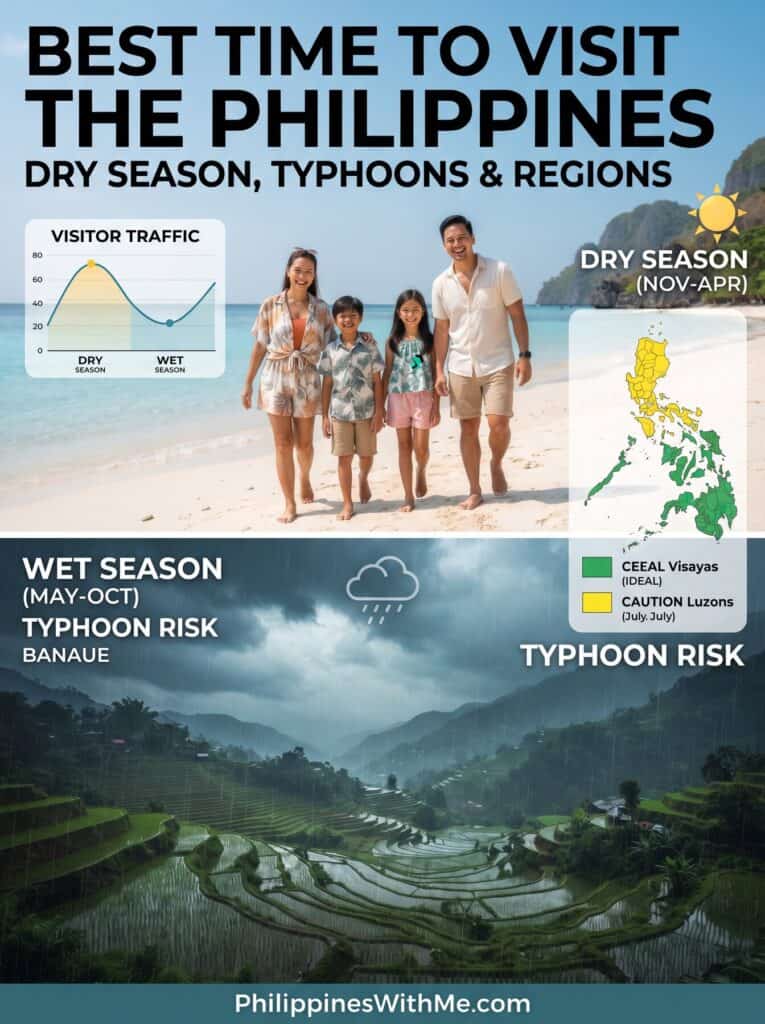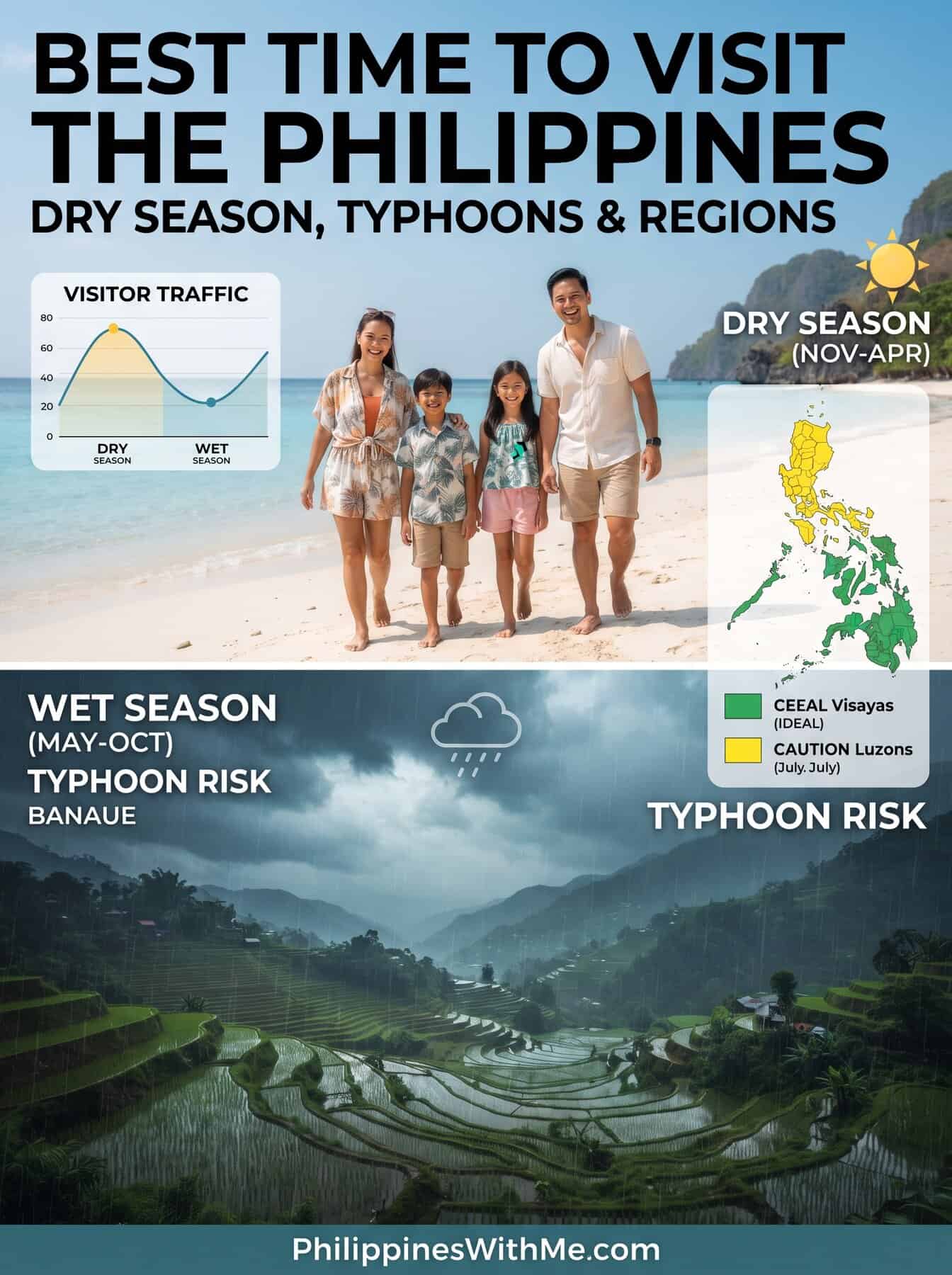
Working out the best time to visit the Philippines comes down to one question: which islands are you going to? The country stretches across more than a thousand miles of sea, so a sunny week in Palawan can coincide with a stormy one in Eastern Visayas. Broadly, the dry season from roughly November to April is the most popular and reliable window, while June to October brings the monsoon rains and typhoon risk. This guide walks through the overall pattern, a month-by-month table, regional differences, the amihan and habagat winds, and the best months for beaches, diving, surfing and the mountains.
Best Time to Visit the Philippines: Quick Answer by Destination
There is no single best time for the whole country, so the answer depends on where you are going:
| Destination | Best time | Avoid or expect |
|---|---|---|
| Palawan (El Nido, Coron) | December to April, with March often the driest | Wet-season rain can close the Underground River |
| Boracay and Cebu | November to April | June to September brings the habagat winds and rain to White Beach |
| Siargao | August to November for surf | Faces the Pacific, so it does not follow the Palawan calendar and sits inside typhoon season |
| Luzon (Manila, Ilocos, Baguio) | Roughly November to April | June to September is the wettest period |
| Davao and Mindanao | No single dry season | Check forecasts closer to your dates |
For island-by-island detail, see the best islands in the Philippines and the sections below.
The Big Picture: Dry Season vs Wet Season
Most of the Philippines runs on two broad seasons, and knowing them is the first step in choosing the best time to visit the Philippines. The dry season, usually November to April, brings sunshine, calm and clear seas, and ideal conditions for outdoor activities. The best overall stretch is generally December to February, when temperatures are cooler and rainfall is minimal. By March and April the weather turns hot, and Filipino summer can feel punishing in the middle of the day. The wet season, the part of the year that shapes the best time to visit the Philippines for budget travelers, runs roughly June to October. Rain often falls in quick, heavy bursts, particularly in the afternoon, with drier mornings and evenings. Landscapes are lush, prices are lower and crowds thin out. The downside is that heavy weather can disrupt flights and ferries and make remote roads hard to use. Our typhoon season guide covers how storms work and how to plan around them. Treat these as patterns rather than promises. Some regions have no clear dry season at all, and storms can appear outside the official window. Always check the forecast from the national weather agency, PAGASA, before you fly or book a ferry.
Month-by-Month Guide to the Best Time to Visit the Philippines
The table below is a general guide for the popular dry-season destinations. Conditions in the south and east can differ, as explained in the regional section. Weighing the Philippines against its neighbor? Our Philippines versus Indonesia comparison sets the two side by side.
| Month | Typical conditions | Crowds and prices | Notes |
|---|---|---|---|
| January | Dry, cool amihan breeze | Peak | Sinulog (Cebu), Ati-Atihan (Kalibo); strong wind at Bulabog |
| February | Dry, still comfortable | Peak | Panagbenga in Baguio |
| March | Dry and getting hot | High | Palawan at its driest on average; Holy Week can fall here |
| April | Dry and hot | High | Holy Week can fall here; very hot |
| May | Transition, hot, first rains | Shoulder | Pahiyas in Lucban; good-value month in many places |
| June | Wet season begins, habagat starts | Low | Typhoon season officially starts |
| July | Wet, peak typhoon risk | Low | Landslide risk in the mountains |
| August | Wet, peak typhoon risk | Low | Kadayawan in Davao; Siargao surf season starts |
| September | Wet, showery | Low | Cheap rates, patchy weather |
| October | Wet but easing in the north | Shoulder | MassKara in Bacolod; Siargao surf season |
| November | Drying out, amihan returns | Shoulder | Central and southern areas can still see storms |
| December | Dry, cooler, festive | Peak | Christmas and New Year; book far ahead |
The monthly guide does not apply equally everywhere: eastern areas with Type II rainfall peak around November to January, and Type IV areas such as Davao and Bohol have no clear dry month, so use the regional section for those. Festival dates move from year to year and some, like Holy Week, depend on the calendar, so confirm them before booking. Our public holidays and festival calendar lists what to expect.
Best Time to Visit the Philippines by Region
Compare options in our best islands in the Philippines by traveler type. To pick the best time to visit the Philippines for your destination, note that PAGASA classifies the country into four climate types based on rainfall. Knowing which type your destination falls under is more useful than any national average.
- Type I: two pronounced seasons, dry from about November to April and wet for the rest of the year, with the heaviest rain from June to September. This covers Metro Manila, Ilocos, La Union, Benguet, Pangasinan, Zambales, Batangas, Iloilo and the western section of Palawan.
- Type II: no dry season and a very pronounced rainfall peak from about November to January. This includes Northern and Eastern Samar and Agusan del Sur.
- Type III: seasons are not very pronounced, relatively dry from November to April and wet the rest of the year. Examples include Aklan, Cebu, Bukidnon and North Cotabato.
- Type IV: rainfall more or less evenly spread through the year. This includes Davao, Bohol, Leyte, Misamis Oriental and South Cotabato.
These climate types are a general map based on rainfall, and conditions vary by locality and by year, so use them as a starting point. Source: PAGASA climate classification. Last checked: 21 October 2026.
Palawan
Western Palawan follows the classic dry-season pattern. Palawan is generally recommended for the dry months of December to April, with March the driest month on average, while El Nido is usually best from December to April or May. In the wet months the Puerto Princesa Underground River can close when water levels rise. Our Palawan travel guide goes deeper on island-by-island timing.
The Visayas: Cebu, Bohol and Boracay
Cebu and Aklan, where Boracay sits, fall under Type III, so expect the driest weather from November to April. Bohol is Type IV, so showers can appear in any month. For Cebu planning, see our Cebu travel guide, and for Boracay specifically the Boracay travel guide.
Siargao and the East
Siargao faces the Pacific, which changes the equation: the island is at its best for surf in the second half of the year, as described below, and it does not follow the Palawan calendar. Eastern regions classified as Type II can see their rainiest period around December and January, exactly when the west is at its best.
Luzon
Metro Manila and the northwest are Type I, so roughly November to April is the dry window and June to September the wettest period. Early-season typhoons tend to pass the northern regions, which matters for Batanes and northern Luzon.
Mindanao
Davao and much of Mindanao are Type IV, with rainfall spread more evenly through the year, so there is no single wet or dry season to plan around. Local conditions matter more than the calendar, so check forecasts closer to your dates.
Amihan and Habagat: What the Winds Mean
For storm-season specifics, see our guide to Philippine typhoon season. Two monsoon winds shape much of the year. The amihan, the northeast monsoon, blows from around November to April and generally brings cooler, drier weather. The habagat, the southwest monsoon, arrives around June and brings the rain and rougher seas of the wet season.
Boracay
Boracay is a textbook example. During the amihan, the wind arrives from the north-northeast, which suits kitesurfing at Bulabog Beach on the east side, with January and February the prime wind months. During the habagat, roughly June to September, the wind hits from the southwest, onto White Beach, which is why it is the low season there and why kitesurfing is not allowed on that side. If you are weighing it against another island, our Boracay and Palawan comparison shows how the seasons stack up.
Siargao and surf
Siargao flips the script. Its main surf season runs from about August to November, when much of the swell energy generated in the Pacific arrives and the prevailing wind is offshore. Cloud 9, the island’s best-known right-breaking reef wave, hosts the Siargao Cup. Beginners can still find forgiving waves outside the peak, but if you want the heavier swell, aim for the second half of the year and accept some typhoon risk. Our Siargao guide has the details.
Best Time to Visit the Philippines: Peak vs Lean Season
Peak season runs from late December through April, matching dry weather with Christmas, New Year and Holy Week. Demand pushes accommodation prices up, and popular spots such as Boracay, Cebu, Palawan and Davao can double or triple in price during the busiest periods. Booking three to four months ahead is commonly advised for these dates. Holy Week falls in late March or April, depending on the year, and triggers a domestic travel surge. The lean season, roughly June to October, offers lower prices and quieter beaches. The sweet spots are the shoulder periods: November before the Christmas rush, and May before the rains settle in. Whatever dates you choose, check that your passport and entry requirements are in order, starting with our visa guide.
Festival Timing and the Best Time to Visit the Philippines
See the full Philippines festival calendar for exact dates. Festivals can be a reason to travel or a reason to avoid a place, since rooms sell out and prices rise. Notable examples:
- January: Sinulog in Cebu City and Ati-Atihan in Kalibo, Aklan.
- February: Panagbenga, Baguio City’s month-long flower festival.
- May: Pahiyas in Lucban, Quezon, where houses are decorated with colorful rice decorations.
- August: Kadayawan in Davao City, held in the third week of August.
- October: MassKara in Bacolod City, around the fourth Sunday of the month.
Exact dates change, so confirm them with local tourism offices before you book.
Best Time to Visit the Philippines by Trip Type
Planning a surf trip? See our Siargao 5-day itinerary for surfers.
Beach holidays and island hopping
December to April is the safest window, with March generally the driest month in Palawan. If you want fewer people, go in late February through April or in November, and avoid Christmas week and Holy Week.
Diving
Visibility varies by site and season. Apo Island is often recommended for March to May and for the cooler months of November to February, while July and August are rainy and less ideal. Malapascua, famous for thresher sharks at Monad Shoal, is often recommended from June to December. Tubbataha Reef is best from March to June. Check with local operators, since they know current conditions.
Surfing
Siargao is best from August to November for strong Pacific swell with offshore winds. Pair this with flexible flights, since the same months fall inside typhoon season.
Hiking, Sagada and Baguio
In the mountains, November to February is cool and dry, with Sagada averaging around 15 to 17 degrees Celsius. December is busy, so November or January can be calmer. From July to August landslides are more frequent, and local tourism offices warn of fog, low visibility and winding roads in the rainy months. Caves such as Sumaguing can become dangerous when water rises fast. March and April bring the greenest rice terraces but also warm, dusty days. Baguio hosts Panagbenga in February, so book early if you want to catch it.
Planning Around Weather Risk
For a full route, see our Davao travel guide.
- Build a spare day or two around ferries and island-hopping flights, especially from June to November, and check PAGASA, the national weather agency, before any inter-island leg.
- Choose flexible airfares and buy travel insurance that covers weather disruption.
- Check PAGASA bulletins daily during storm season, and follow local advice and tour operator cancellations.
- Pack a light rain jacket even in the dry season, and read our packing advice before you go.
Frequently Asked Questions About the Best Time to Visit the Philippines
Quick answers on the best time to visit the Philippines, asked most often.
What is the best month to visit the Philippines?
It depends on your destination. For most travelers aiming at beaches and island hopping in the west and the Visayas, December to February offers the best balance of dry weather, cooler temperatures and calm seas. Expect higher prices and crowds. If you want sunshine with slightly fewer people, try late February to early April or the shoulder weeks in November and May.
Is it worth visiting the Philippines in the rainy season?
Yes, if you are flexible. The wet season brings lower prices, fewer crowds and green scenery, and rain often arrives in short, heavy bursts rather than all day. The trade-offs are possible flight and ferry disruption, rough seas and typhoon risk, so buy flexible tickets and travel insurance, and leave buffer days.
When is typhoon season in the Philippines?
PAGASA describes the typhoon season as usually running from June to November, with July and August the most active months. Early in the season storms tend to pass the north, while from October to December the central and southern regions are more exposed. Storms outside these months are possible but less common.
Which part of the Philippines is driest in summer?
No part is reliably dry all year. Under PAGASA’s climate types, Type I areas such as western Palawan, Metro Manila and Ilocos have a pronounced dry season, while Type IV areas such as Davao and Bohol have rainfall spread more evenly through the year.
When should I avoid traveling to the Philippines?
Many travelers avoid the heart of the typhoon season, roughly July to September, particularly for island hopping, remote ferries and mountain roads. Holy Week and the Christmas to New Year stretch are not dangerous, but they are the most expensive and crowded, so avoid them if you are on a tight budget.
When is the best time for diving and surfing?
Diving is generally best in the calmer dry months, though some sites follow their own calendar: Malapascua is often recommended from June to December. Siargao’s main surf season runs from about August to November. See the sections above to match your activity to the month. To match a season to a destination, see the best islands in the Philippines and how each handles the weather.
What is the best time to visit Palawan?
December to April is generally the best window, with March often the driest month. In the wet months the rain can close attractions such as the Puerto Princesa Underground River.
What is the best time to visit Boracay?
November to April is the dry season and the most reliable time for White Beach. January and February are prime for kitesurfing at Bulabog, while June to September brings the habagat and the low season on the west side.
What is the weather like in the Philippines in December?
December is generally dry and cooler across much of the country, and it is peak season for Christmas and New Year, so book far ahead. Eastern areas with Type II rainfall can be at their wettest around this time.
When is the rainy season in the Philippines?
The wet season runs roughly from June to October for most of the country, with the heaviest rain from July to September, while the dry season runs from about November to April. Some regions have no clear dry season at all.
Bottom Line: Best Time to Visit the Philippines
For the broadest choice of beaches, December to February is the best time to visit the Philippines, with late February to April and November as smart ways to dodge the peak. Choose your region first, match it to its climate type, then set dates around your activity, whether that is kitesurfing, diving, surf or mountain trekking. Stay flexible during the wet months and the islands reward you with green scenery and empty beaches.