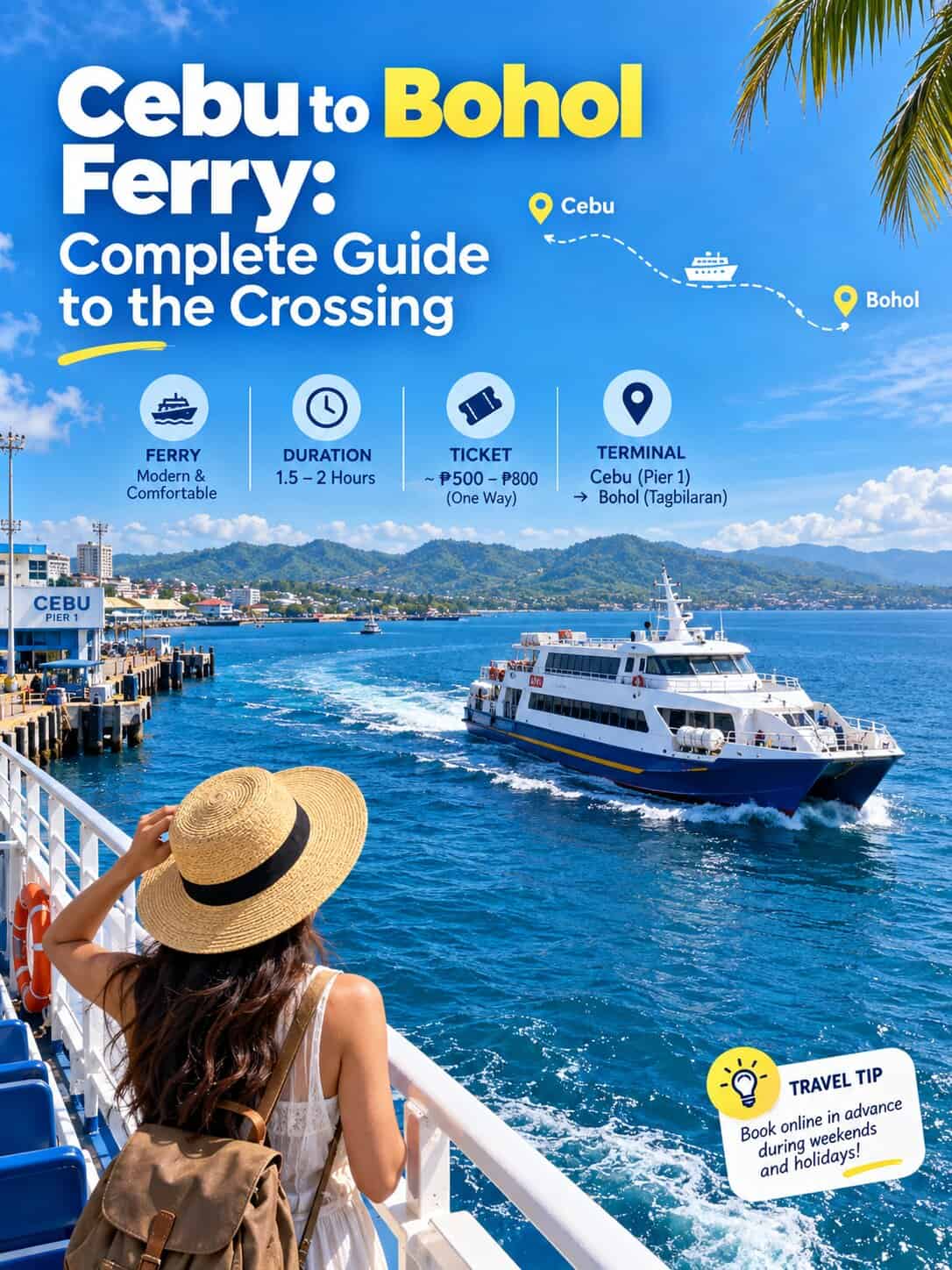
The Cebu to Bohol ferry is the classic way to island-hop in the Central Visayas: you leave from the busy waterfront of Cebu City, cross the Cebu Strait and arrive in Tagbilaran, the capital of Bohol, in about two hours on a fast craft. It is cheap compared with flying, it runs from city centre to city centre, and it is often the first leg of a trip that continues to Panglao’s beaches and the Chocolate Hills. This guide covers how the crossing works, how to book it, what to expect on board, and how to get onward from the port, without quoting fares or fixed timetables, because both change and should always be checked with the operator.
How the Cebu to Bohol Ferry Route Works
The main crossing connects the port area of Cebu City on Cebu’s east coast with Tagbilaran City Port on the southwest tip of Bohol. Cebu City’s piers sit close to the old downtown, so many travelers reach them by taxi or ride-hailing from their hotel rather than from the airport directly. If you are landing at Mactan first, our Cebu airport guide explains how to get from the airport into town, and the Cebu travel guide helps you decide where to base yourself before the crossing. Fast ferries are the standard choice for visitors. These are enclosed, air-conditioned passenger craft with assigned or open seating, usually in a few classes of seating. Slower vessels, including ones that also carry vehicles and cargo, exist on some routes and take noticeably longer; they suit travelers with a car, a motorbike or plenty of time rather than most tourists.
Operators
Several companies have served the Cebu to Tagbilaran route. OceanJet runs the fast craft between Cebu City Pier 1 and Tagbilaran City Port, with several departures through the day from the early morning to the early evening. Lite Ferries covers the same pair with slower conventional vessels. Weesam Express has also been listed on the route. Which operator runs which departure changes periodically, so treat any timetable you see in a blog post, including this one, as indicative only. Use the operator’s official website, app or terminal counter, or a ferry booking platform, to see current departures.
Typical Duration
Plan on roughly two hours of sailing for a fast ferry from Cebu City to Tagbilaran; The OceanJet fast craft takes about 2 hours. Individual sailings can be somewhat shorter or longer depending on the craft and the sea state. Slower conventional vessels take longer: Lite Ferries sails from Cebu Pier 1 to Tagbilaran in about 4 hours, with a night departure on most days. Add buffer time at both ends, since check-in, security and boarding all take a while.
Cebu to Bohol Ferry Fares and Departure Times
Fares below are adult one-way prices in Philippine pesos. The classes differ in seating and baggage allowance rather than speed. Operators have added a fuel surcharge since late September 2026, so the amount at checkout can be a little higher than the base fare, and port or terminal fees may be charged separately.
| Route | Operator and class | Departures | Crossing | Adult fare |
|---|---|---|---|---|
| Cebu Pier 1 to Tagbilaran | OceanJet, Tourist / Open Air | About 13 sailings, from 05:10 to 17:40 | About 2 hours | ₱960 |
| Cebu Pier 1 to Tagbilaran | OceanJet, Business | Same sailings | About 2 hours | About ₱1,440 to ₱1,450 |
| Tagbilaran to Cebu Pier 1 | OceanJet | From 06:00 to 17:40 | About 2 hours | ₱960 in Tourist |
| Cebu Pier 1 to Tagbilaran | Lite Shipping, slower RoRo ferry | 22:00 daily, plus 13:00 on Monday, Wednesday and Saturday | About 4 hours | From about ₱520 |
| Cebu Pier 3 to Tubigon | Lite Shipping, LiteCat | 01:00, 04:00, 07:00, 10:00, 13:00, 16:00, 19:00, 22:00 (the 01:00 does not run every day) | About 2 hours | Economy ₱396, Tourist ₱468, Business ₱540; children half price |
| Cebu Pier 2 to Tubigon | FastCat | 01:30, 07:30, 13:30, 20:00 | About 2 hours | Economy ₱438, Premium Economy ₱490, Business ₱543 |
| Tubigon to Cebu Pier 2 | FastCat | 05:00, 10:30, 17:30, 22:30 | About 2 hours | ₱438 to ₱543 depending on class |
| Cebu to Ubay | Cokaliong, overnight RoRo | 20:00, arriving around midnight | About 4 hours | Around ₱540 Economy and ₱600 Tourist |
The number of OceanJet sailings changes by day and season, and the last departure of the day is the one that sells out first on weekends. Check the exact time for your date on the booking page before you plan the rest of your day. Tourist class on OceanJet includes 10 kg of free baggage. See the sailings and fares for your date.
Other Crossings Between Cebu and Bohol
Tagbilaran is not the only link between the two islands. Lite Ferries sails between Cebu and Tubigon in northern Bohol; the Lite Cat fast craft takes about 2 hours, with sailings roughly every three hours, day and night, from Cebu Pier 3 (Passenger Terminal 2). Roll-on roll-off ferries from Cebu Pier 3 reach Ubay in eastern Bohol in roughly 4 to 5 hours, and Jagna has been served by long, infrequent overnight sailings. These routes are aimed at local passengers, cargo and vehicles, and their frequency and operators vary a lot. They can be useful if you are heading to northern or eastern Bohol, but for first-time visitors the Cebu City to Tagbilaran crossing is the practical default because of its frequency and the onward transport at the other end. Confirm any less common route is currently operating before planning around it.
| Crossing | Best for | Things to keep in mind |
|---|---|---|
| Cebu City to Tagbilaran | Most visitors, Panglao and the Chocolate Hills | Most frequent and best-known; peak days fill up |
| Cebu to Tubigon, Ubay or Jagna | Northern and eastern Bohol, locals, vehicles | Tubigon is about 2 hours; Ubay roughly 4 to 5 hours; services and piers vary, so verify first |
| Flight Cebu to Tagbilaran or Panglao | Tight schedules, onward flight links | Availability varies; airport transfers add time |
Buying Cebu to Bohol Ferry Tickets
You can generally buy tickets in two ways: online through the operator’s official channels, or in person at the terminal. Booking online ahead of time lets you choose a departure and, on some services, a seat class, and it removes the risk of arriving to a sold-out sailing. Buying at the terminal is common and often works on quiet weekdays, but you may need to take whichever departure still has seats.
- Use official operator websites, apps or ticket counters only, and be wary of anyone offering tickets in the street.
- Bring a valid photo ID, since OceanJet asks for a valid ID that matches the name on the ticket at check-in; student, senior and PWD fares are for Filipino nationals only and require a photo of the ID at purchase.
- Read the booking terms on changes, refunds and rebooking, particularly if the weather is uncertain.
- Arrive early. OceanJet requires check-in at least 30 minutes before departure, and the cutoff can be strict.
Peak Days and Holidays
Expect crowded sailings on weekends, long weekends, school holidays, Holy Week and the Christmas and New Year period, when many Filipinos travel between the islands. During those windows, book as early as you can and avoid scheduling tight connections on the same day. Our public holidays and festival calendar can help you spot busy dates when planning your trip.
Sea Conditions and Typhoon Cancellations
The Cebu Strait is usually manageable, but this is open sea, not a lake. Strong winds, rough water and tropical cyclones can lead to delayed or cancelled sailings, and the Philippine Coast Guard can suspend departures for certain vessels when conditions are unsafe. Sailings are often calmer in the morning, and the northeast monsoon season brings rougher seas on some routes. The typhoon season, broadly the second half of the year, brings the highest risk, and our typhoon season guide explains the pattern in more detail.
- Check the forecast and official bulletins from PAGASA in the days before you go.
- Keep a buffer day before any international departure, so a cancelled sailing does not make you miss a flight.
- If your sailing is cancelled, ask the operator about rebooking or refund options, and keep your receipts. OceanJet gives a full refund of the ticket value if it cancels the voyage.
- Consider travel insurance that covers weather disruption.
From Tagbilaran Port to Panglao and the Chocolate Hills
Tagbilaran City Port is on the southwest of Bohol, and the main tourist destinations radiate out from it. Panglao Island, which has most of Bohol’s beach resorts and diving, is joined to the mainland by bridges; Alona Beach is about 12 km from Tagbilaran, and the pier to Alona run takes roughly 30 to 45 minutes by van, hired car or tricycle depending on traffic. The Chocolate Hills in Carmen are around 55 km inland, typically 1.5 to 2 hours each way, so most visitors reach them on a tour or hired vehicle; buses and vans to Carmen leave from the Dao Integrated Bus Terminal.
- Taxis and tricycles: Easy to find outside the port for the ride to Tagbilaran city or Panglao. Agree on the price first if there is no meter.
- Vans and transfers: Many resorts and tour providers offer pickups, which is convenient with luggage or in a group.
- Private car or van with driver: The usual choice for a day covering the Chocolate Hills and other mainland sights. This often works out sensible for groups when costs are split.
- Motorbike or scooter rental: Possible for experienced riders, but roads can be busy and weather can change quickly.
For the sights themselves, read our guide to the Chocolate Hills and Panglao, and for the island as a whole, see the Bohol destination guide. If you are choosing where to sleep, our roundup of the best resorts in Panglao compares options by area and style, and our Cebu vs Bohol comparison helps if you are still deciding how to split your time between the two islands.
Tagbilaran Port to Panglao: Prices and Travel Time
| Option | Price | Time |
|---|---|---|
| Taxi or tricycle to Panglao or Alona Beach | ₱300 to ₱500 for the whole vehicle | 25 to 45 minutes |
| Private car transfer booked in advance | ₱1,000 to ₱1,500 for the whole car | 25 to 45 minutes |
| Public bus from the Dao terminal | About ₱70 to ₱85 to Panglao airport, about ₱100 to Alona Beach | 30 to 45 minutes |
Taxi and transfer prices are per vehicle, not per person, so a group of three or four people splits the cost. Bus timetables from the Dao terminal are not fixed, so allow extra time if you rely on them.
Luggage and What to Bring on Board
Fast ferries generally allow ordinary travel luggage, but allowances differ by operator and ticket class. On OceanJet the free allowance is 10 kg in Tourist and Open-Air and 20 kg in Business Class, and trolley or collapsible bags in Tourist and Open-Air must go into checked baggage rather than the cabin. Large bags usually go in a dedicated luggage area, and you may be asked to leave some bags at a designated spot.
- Keep passports or IDs, medication, cash and electronics in a small bag you carry with you.
- Use a lock or tag on checked bags, and take a photo of your luggage.
- Pack a light jacket, as air-conditioned cabins can be cold.
- Bring a water bottle and a small snack, though terminals and vessels usually have basic food for sale.
- If you are carrying a surfboard, a dive bag or other oversize items, ask the operator in advance.
Seasickness Tips
Most travelers find the crossing comfortable, but fast craft can bounce in choppy water. If you are prone to motion sickness, sit toward the middle of the vessel on a lower deck if possible, keep your eyes on the horizon and avoid reading or looking at your phone for long periods. Eat lightly beforehand, avoid alcohol the night before, and ask a pharmacist or doctor about a suitable remedy. Morning departures are often calmer. Spending time in fresh air, where the operator allows access to open decks, can also help.
Day Trip or Overnight in Bohol?
A same-day return is technically possible, because fast ferries run during the day and the crossing is about two hours each way. In practice, it is a tiring day: you spend roughly four hours at sea, plus time at both ports, and you leave little time for sights. It can work for a quick visit to Tagbilaran or Panglao, but it is not ideal for the Chocolate Hills, which are well inland.
| Option | Works well if | Drawbacks |
|---|---|---|
| Day trip | You are short on time and want a taste of Bohol | Long travel time, rushed sightseeing, risk of missing the last sailing |
| One night | You want the Chocolate Hills and a bit of Panglao | Still a quick pace |
| Two or more nights | You want beaches, diving, and mainland sights | Requires more days in your itinerary |
If you are pulling the whole trip together, our 4-day Cebu and Bohol itinerary shows one way to combine both islands without too much rushing.
Ferry or Flight?
Flying is the alternative for people who want to avoid the sea, but it is not always the better option. The flight itself is short, yet airport check-in, security and transfers eat into the savings, and services on short domestic routes can change. The ferry, by contrast, runs between ports that are close to town. Whichever option you choose, build in some slack in case of delays, and book your onward arrangements to be flexible. For general information on traveling in the country, the Department of Tourism’s official site is a good starting point, and for maritime advisories you can check the Philippine Coast Guard.
Practical Checklist
- Decide on a base in Bohol and book accommodation before you cross.
- Check current departures with the operator, then book early for peak dates.
- Bring ID, a light jacket and your valuables in a carry bag.
- Arrange your onward transfer from Tagbilaran, either in advance or by taxi or van at the port.
- Check the weather forecast the day before and keep some flexibility.
- Keep a buffer day before any international flight.
Frequently Asked Questions
How long is the Cebu to Bohol ferry?
On the main fast-ferry route between Cebu City and Tagbilaran, expect roughly two hours of sailing, sometimes a little more or less depending on the vessel, the operator and sea conditions. Add time for check-in, boarding and getting to and from the ports. Always confirm the duration for your specific departure when you book.
Which companies run ferries from Cebu to Bohol?
OceanJet runs the fast craft on the Cebu City to Tagbilaran crossing, and Lite Ferries sails the slower conventional vessels. Operators, routes and timetables change over time, so check each company’s official channels for what is currently running.
Can I buy Cebu to Bohol ferry tickets on the day?
Often yes, at the terminal ticket counters, but that is a gamble on busy days. For weekends, school holidays, Holy Week and the Christmas season, book ahead online or through the operator so you are not left waiting for a later sailing.
Do ferries get cancelled because of weather?
Yes. Sailings can be delayed or cancelled when the Philippine Coast Guard restricts departures during storms or strong winds, especially when a tropical cyclone is nearby. Keep flexibility in your plans and follow official weather bulletins.
Is it better to take the ferry or fly from Cebu to Bohol?
For most travelers the ferry is simpler: it links two city-centre ports and avoids airport transfers. Flying can make sense if your schedule is tight or your flights are already booked into Bohol, but check current availability, since services on short routes change.
How do I get from Tagbilaran port to Panglao?
Taxis, tricycles and pre-arranged transfers or vans are the usual options for the short ride to Panglao island’s beaches. Agree on the price before you set off if the vehicle has no meter, or book a transfer through your accommodation.
Can I do Bohol as a day trip from Cebu?
It is possible, but it makes for a long day with a lot of time on the water. If you want to see the Chocolate Hills and other mainland sights, staying at least one night is far more comfortable.
What can I do about seasickness on the ferry?
Pick a seat in the middle of the vessel, look at the horizon, eat lightly beforehand and take a motion-sickness remedy as advised by a pharmacist or doctor. Sailing in the morning, when the sea is often calmer, can also help.
Bottom Line
The Cebu to Bohol ferry is the easiest and most popular way to cross between the two islands: a roughly two-hour fast-ferry ride between two port cities, with taxis and vans waiting at the other end. Book ahead for busy dates, check the weather, travel light, and plan at least one night on Bohol so the crossing leads to more than a rushed day. Always confirm operators, timetables and fares directly with the official sources before you go.