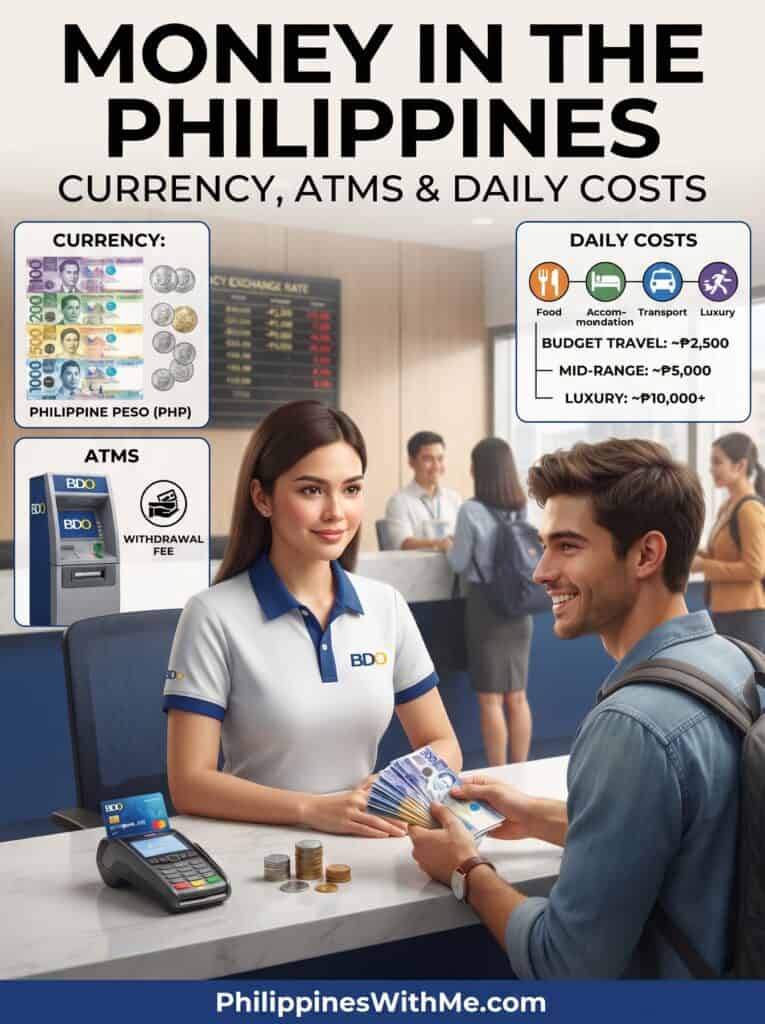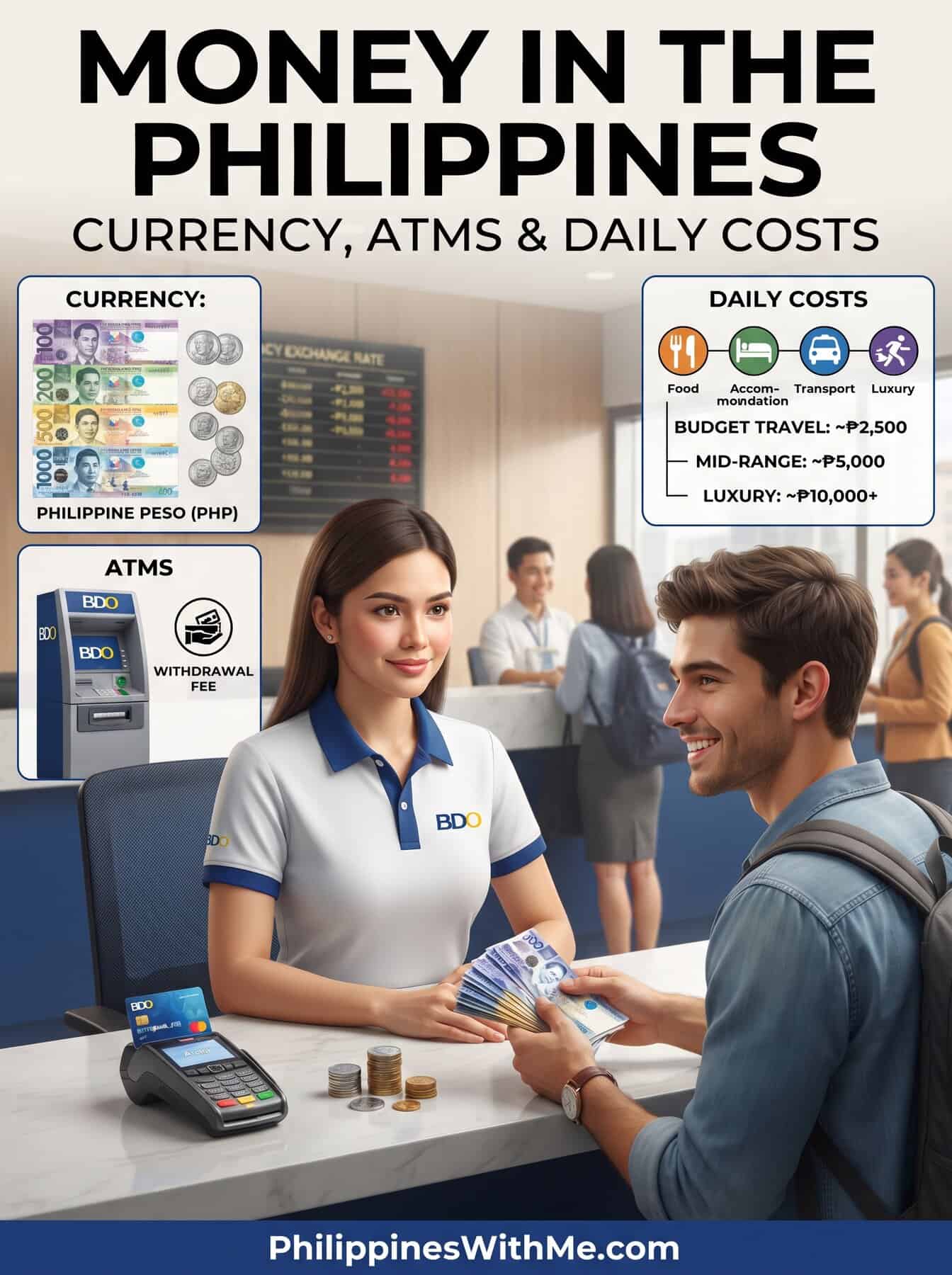
Knowing the Philippines currency and planning your cash before you land makes the first days far smoother, and this guide to money in the Philippines covers what you need: the currency, how and where to get pesos, when cards and e-wallets work, what things cost, and where cash runs short. The country is a cash-first destination outside the big cities. Once you know the basics, you can enjoy the islands without hunting for a working machine. Think of this page as a planning companion to the visa guide and the advice on SIM cards and eSIMs, since mobile data and payment apps tend to go together.
Philippines Currency: Quick Answer
The Philippines currency is the Philippine peso (PHP, ₱). Banknotes come in ₱50, ₱100, ₱200, ₱500 and ₱1,000, and the coins you will use are ₱1, ₱5, ₱10 and ₱20. Cash is still the main way to pay outside big cities, while cards work in malls, hotels and larger restaurants, and e-wallets such as GCash are common with locals.
Cash vs Card vs ATM vs E-Wallet
| Method | Works well for | Watch out for |
|---|---|---|
| Cash | Jeepneys, tricycles, markets, street food, small islands, tips | Large notes are hard to break, so carry small bills |
| Card | Hotels, malls, larger restaurants in Manila, Cebu and resort areas | Surcharges at some businesses and the DCC prompt |
| ATM | Topping up pesos in cities and malls | Flat fees per withdrawal and low per-transaction limits |
| E-wallet (GCash, Maya) | QR payments in cafés and shops if you are eligible | Eligibility and limits for foreigners change, so confirm first |
Philippines Currency: Symbol, Notes and Coins
The Philippines currency, the peso, is written with the symbol ₱ (you will also see PHP or P on price tags and in banking apps). One peso is divided into 100 centavos, which locals often call sentimos. The Bangko Sentral ng Pilipinas (BSP), the central bank, is the national agency responsible for printing and minting the currency,.
Banknotes
Banknotes in circulation come in denominations of ₱50, ₱100, ₱200, ₱500 and ₱1,000. Newer polymer versions of the ₱1,000 note (from 2022) and of the ₱500, ₱100 and ₱50 notes (released in limited quantities from late 2024) circulate alongside the older paper notes, and both are legal tender. The older ₱20 paper note is being phased out in favor of the ₱20 coin. The BSP began releasing the New Generation series in December 2010 and later issued enhanced notes with tactile marks that help people with visual impairments tell denominations apart. For visitors the practical point is simple: the ₱1,000 note is the one ATMs love to dispense, and it is also the one that small vendors struggle to break. Get into the habit of turning large notes into smaller ones whenever you pay at a mall, supermarket or convenience store.
Coins
The coins you will actually use are ₱1, ₱5, ₱10 and ₱20, with the ₱20 coin replacing the old note. Smaller coins of 1, 5 and 25 centavos exist but are rarely used. Coins matter more than you might expect, because they pay for jeepney and tricycle rides, public toilets, and small street snacks.
Condition of the notes
Ordinary wear is fine. A bill that is old, faded or creased is generally still accepted, but notes that are torn, stained, written on or stapled may be turned down by shops and drivers. If you are handed a damaged bill in change, politely ask to swap it on the spot rather than hoping to pass it on later.
Exchanging Philippines Currency and Checking the Rate
Landing in Manila? See our Manila airport guide for exchange counters and transfers. Exchange rates for the Philippines currency move every day, so this guide does not quote one — check the Bangko Sentral ng Pilipinas, the central bank, for the reference rate. Check a live rate on a currency app or your bank before you travel, and compare it with what the booth is actually offering. Cash exchange is easy in the main hubs. You will find money changers at airports, in shopping malls and in tourist areas, and travelers report that they usually beat the banks on rates. At Manila airport the booths post US dollar rates clearly and the competition is stiff. The most useful rule is to bring US dollars if you want to exchange cash, because less common currencies such as euros, pounds or Australian dollars can show much wider differences between booths. If you land at Manila airport (NAIA), change only a small amount there to cover transport and a meal, then use a mall changer or an ATM in the city. A few habits protect you from poor deals. Ask for the final peso amount before handing over money, count the notes at the counter, and avoid unlicensed street changers. Fresh, undamaged foreign notes tend to get better treatment than worn ones.
Paying with Philippines Currency: Cash, Cards and E-Wallets
Cash is still king
The Philippines remains a cash-centric economy, so the local currency matters. Department stores, hotels, malls and larger restaurants in Manila and Cebu usually take cards. Smaller shops, local eateries, markets, and anything involving jeepneys, tricycles, boats or tips generally need cash. Some businesses add a surcharge of a few percent for card payments, so ask before you tap. Carry small notes and coins every day, and keep them separate from your large bills.
Credit and debit cards
Visa and Mastercard are the safest bets. Use a card with no foreign transaction fee if you have one. If a terminal or ATM offers to charge you in your home currency, see the dynamic currency conversion warning below. Tell your bank you are traveling so that your card is not blocked on the first swipe.
GCash and Maya
E-wallets are everywhere in the Philippines, and QR payments are common in cafes, shops and even some market stalls. GCash, the largest wallet, now offers a service called GTourist that gives eligible foreign visitors temporary access, roughly 30 days, to selected GCash features using a non-Philippine mobile number. Registration requires a foreign passport and is only activated when you are physically in the country. GCash and Mastercard have also announced a Mastercard Pay Local service for eligible foreign travelers to link their cards, targeted for the third quarter of 2026, so check in the app whether it is live and which cards qualify. Maya, the other major wallet, accepts a foreign passport for account verification. Because eligibility, limits and features change, treat all of this as something to confirm in the app before you rely on it, and still carry cash as a backup. Mobile signal also affects wallets, so see our guide to SIM cards and eSIMs before you go.
Philippines Currency at ATMs: Fees, Limits and Safety
For broader safety tips, see Is the Philippines safe for tourists?. ATMs are plentiful in cities and malls, and they are the easiest way to get pesos. Expect two catches: fees and limits. Both vary by bank and change over time, so treat the figures below as typical reports rather than fixed rules. Because each withdrawal carries a flat fee, taking out the largest amount allowed, rather than many small ones, usually costs less overall. Balance that against the risk of carrying too much cash at once, and split it across your bag and your accommodation safe.
Philippines ATM Fees: Three Charges to Know
A single withdrawal can carry up to three separate costs:
- The local ATM fee: many Philippine banks charge foreign cards a flat fee per withdrawal, and travelers commonly report about ₱200 to ₱300, with ₱250 the most often cited. The machine usually shows it on screen before you confirm.
- Your own bank’s fee: your card issuer may add a foreign ATM fee or a percentage on top.
- Currency conversion: a foreign exchange margin, either from your issuer or from the ATM if you accept its conversion offer.
Because the local fee is flat, taking out the largest amount allowed, rather than many small amounts, usually costs less overall. Some banks have been reported to show no fee on screen and still charge it later, so check your statement.
Philippines ATM Withdrawal Limit
Per-transaction limits of about ₱10,000 to ₱20,000 are commonly reported at major banks, so a large amount may need several withdrawals. HSBC machines are often mentioned as an exception, with a higher limit and no fee for foreign cards, but HSBC has few locations. Limits differ by bank, machine and card, and your own bank sets a daily limit too, so do not assume one number applies everywhere. Check the on-screen limit before you confirm and ask your card issuer about its daily cap before you travel.
Dynamic Currency Conversion: Choose Pesos
Some ATMs and card terminals offer to charge you in your home currency instead of pesos, a service called dynamic currency conversion. It looks convenient, but the exchange rate offered is often less favorable than your card network or bank would apply. As a general rule, choose Philippine pesos (PHP) and let your own bank convert, although the difference varies by card, so there is no guarantee of savings.
Skimming and card safety
Card skimming has been reported in the Philippines, including at tourist spots such as Boracay. Police and bank groups advise using machines inside banks or malls and in well-lit places rather than standalone machines on the street. Cover the keypad when you enter your PIN, check the card slot and keypad for anything that looks loose or glued on, and never hand your card to anyone or share your PIN. Set card alerts in your banking app and check your statement after the trip. For broader street-level advice, see our guide on whether the Philippines is safe for travelers.
Philippines Currency on the Islands: Plan Before You Go
Also worth sorting before you fly: our Philippines SIM card guide. This is the single most important money warning in this guide. Smaller island destinations have few ATMs, and the machines that exist can break down or run out of cash. Travelers in El Nido have reported that the main bank machine ran dry and was not refilled for two or three days, and visitors to Coron are often told to expect very limited ATM access. Siargao and other small islands have similar limits, and power cuts can also stop machines and card terminals from working.
- Withdraw before you leave. Top up in Manila, Cebu or at the airport where you land, not on the island.
- Estimate your total. Add accommodation, island-hopping tours, meals, tricycles, entrance fees and a cushion, then bring more than you think you need.
- Carry small bills. Boat crews, tour guides and small guesthouses rarely have change for ₱1,000.
- Ask about card use. Many resorts accept cards, often with a surcharge, but small guesthouses and tour operators may be cash only. Confirm when you book.
- Keep a reserve. Hold one emergency stash apart from your daily cash.
If your route runs through Manila, our Manila travel guide lists the city areas where you will find banks and malls, and the Cebu travel guide does the same for the Visayas, so you can plan a cash stop on the way.
Tipping and Service Charge
Tipping in Philippines currency is appreciated but not rigid. Many restaurants and hotels already add a 10 percent service charge to the bill, and when that appears there is generally no need to tip extra. Check the receipt, because the service charge and VAT are listed separately. If no service charge is added, leaving around 10 percent is customary. There is no fixed rule for taxi drivers, guides or hotel attendants; rounding up the fare or handing over a small amount in cash is common. Give the tip discreetly and directly to the person who served you, with a thank-you, rather than leaving it on a crowded table. For boat crews and guides on multi-day trips, a small cash tip at the end is a kind gesture, though it is not obligatory.
Daily Budget: Budget, Mid-Range and Premium
For a full breakdown, see Philippines travel cost: daily budgets for every style. Published daily budgets for money in the Philippines vary widely between sources, and prices also differ between Manila, Cebu and the popular islands such as El Nido, Boracay and Siargao, which cost more than small provincial towns. Rather than give one figure in Philippines currency, here are the tiers in qualitative terms. Always check current prices before you book.
| Tier | Typically covers | What to expect |
|---|---|---|
| Budget | Dorm beds or simple fan rooms, local eateries, jeepneys and tricycles, free or low-cost activities | The Philippines is one of the cheaper countries in Southeast Asia for backpackers, but island tours and flights can quickly lift your spending. |
| Mid-Range | Private air-conditioned rooms or small resorts, restaurant meals, some guided tours, occasional taxis and ride-hailing | A comfortable middle tier for most visitors. Spending depends heavily on how many tours you add. |
| Premium | Beachfront resorts, private transfers and boats, fine dining, diving or private tours | Prices in resort areas can approach international levels, especially in peak season. |
The big swing factors are accommodation, domestic flights and boat tours rather than food. Meals at local eateries are inexpensive, while restaurants in tourist zones cost noticeably more. If you are linking several destinations, add the cost of flights and ferries early in your budget, because they can easily match several days of ground spending. For a sense of how hotel prices change by area, check current rates directly on booking sites for your dates.
Bargaining and Everyday Prices in Philippines Currency
Bargaining, known locally as tawad, is normal in street markets, with souvenir sellers, and with tricycle drivers. It is not appropriate in malls, supermarkets, restaurants or at hotels with posted rates. Keep it friendly: start lower than your target, smile, and be ready to walk away. For tricycles and any ride without a meter, agree the price before you get in, which prevents disputes at the end. Short local rides can be cheap, while longer or private trips are negotiated and cost much more. Ride-hailing apps and metered taxis avoid the haggling in big cities. Our guide to NAIA explains the airport taxi options that save you from negotiating when you are tired from a long flight.
Tax-Free Shopping and Other Money Notes
Before you travel, check our packing checklist for the Philippines. The Philippines has passed a law, Republic Act 12079, that sets up a VAT refund for non-resident tourists. Under its rules, a purchase from an accredited store must be at least ₱3,000, and the goods must leave the country within 60 days; refunds can be claimed electronically or in cash. The Supreme Court has upheld the law. Because the practical details, such as which stores are accredited and where to claim, can change, ask the shop about it at the time of purchase and check current arrangements at the airport before you depart. A few other points help. Keep your passport copy and a card backup in separate places. Some attractions, national parks and island entrance points charge small fees in cash, so keep small bills ready. Always count your change, particularly in the first days when you are still learning the notes. Keep a record of your spending in a notes app, since island prices add up fast.
Frequently Asked Questions About the Philippines Currency
Quick answers on money in the Philippines, asked most often.
What currency is used in the Philippines?
The Philippine peso (₱, PHP). Banknotes come in ₱50, ₱100, ₱200, ₱500 and ₱1,000, and common coins are ₱1, ₱5, ₱10 and ₱20.
Can I use US dollars in the Philippines?
Prices are in pesos and shops generally expect pesos. US dollars are the easiest foreign cash to exchange at airports and money changers, but you should not plan to pay for everyday items in dollars.
How much do ATMs charge foreign cards?
Fees vary by bank and change over time. Travelers commonly report about ₱200 to ₱300 per withdrawal at major banks, plus your own bank’s charges and any currency conversion margin. Check the fee shown on the screen before you confirm.
What is the usual ATM withdrawal limit?
Per-transaction limits of roughly ₱10,000 to ₱20,000 are commonly reported, so you may need several withdrawals for a large amount. Limits differ by bank and machine.
Can tourists use GCash or Maya?
GCash offers a temporary tourist service called GTourist for eligible foreign visitors, and Maya accepts a foreign passport for verification. Eligibility and limits change, so confirm in the app, and carry cash as a backup.
Do I need to tip in the Philippines?
Tipping is appreciated but not mandatory. If a 10 percent service charge is already on the bill, no extra tip is needed. Otherwise about 10 percent is customary in restaurants.
Is there enough cash and ATM access in El Nido, Coron or Siargao?
Not reliably. ATMs on small islands can be scarce, offline or out of cash, so withdraw enough pesos in a larger city before you go and carry small bills.
Is it okay to bargain?
Yes, in markets and with tricycle drivers and souvenir sellers. Do not bargain in malls, restaurants or at fixed-price shops, and always agree a fare before an unmetered ride. For a full trip-level breakdown by travel style, read our Philippines travel cost and budget guide.
Cash or card in the Philippines?
Carry both. Cards work in hotels, malls and larger restaurants, while cash is needed for transport, markets, small eateries and many islands. Keep small bills and coins for daily spending.
Should I pay in pesos or my home currency when using a card?
Choose Philippine pesos if a terminal or ATM offers a choice. The home-currency option, called dynamic currency conversion, often uses a less favorable rate, although the savings vary by card.
Bottom Line: Money in the Philippines
Money in the Philippines is easy once you accept that cash comes first: carry pesos in small notes, use bank or mall ATMs in the cities, withdraw before heading to the islands, and treat cards and e-wallets as useful extras rather than guarantees. Check live exchange rates, watch for ATM fees, and keep a reserve for the days when a machine is down.