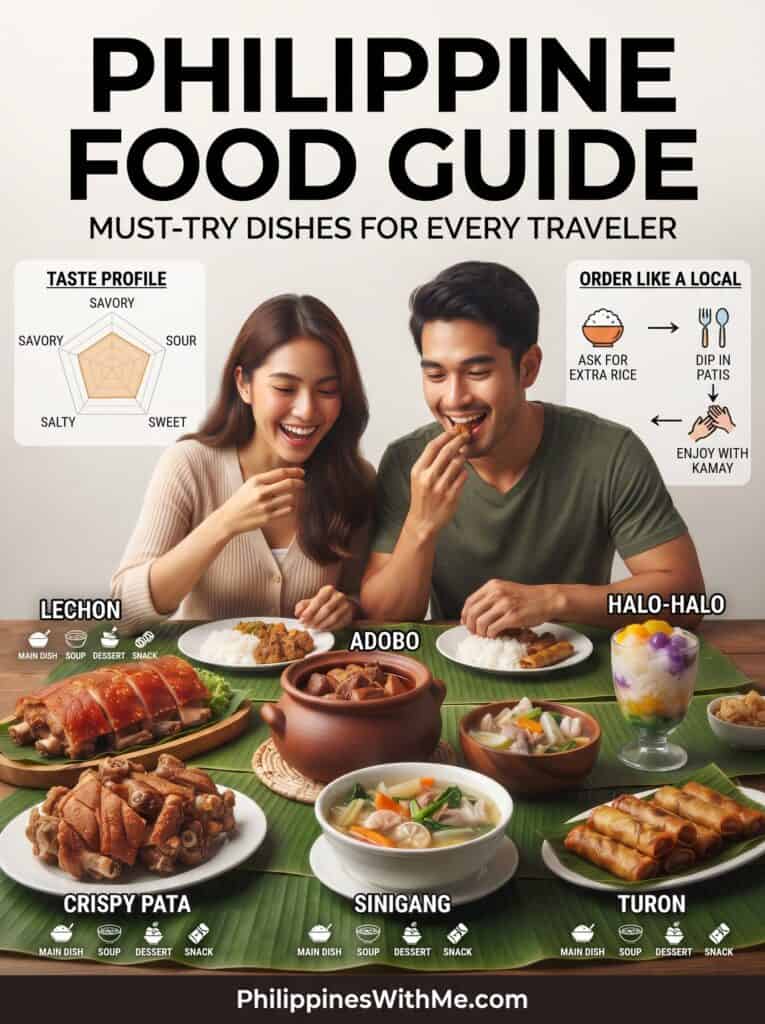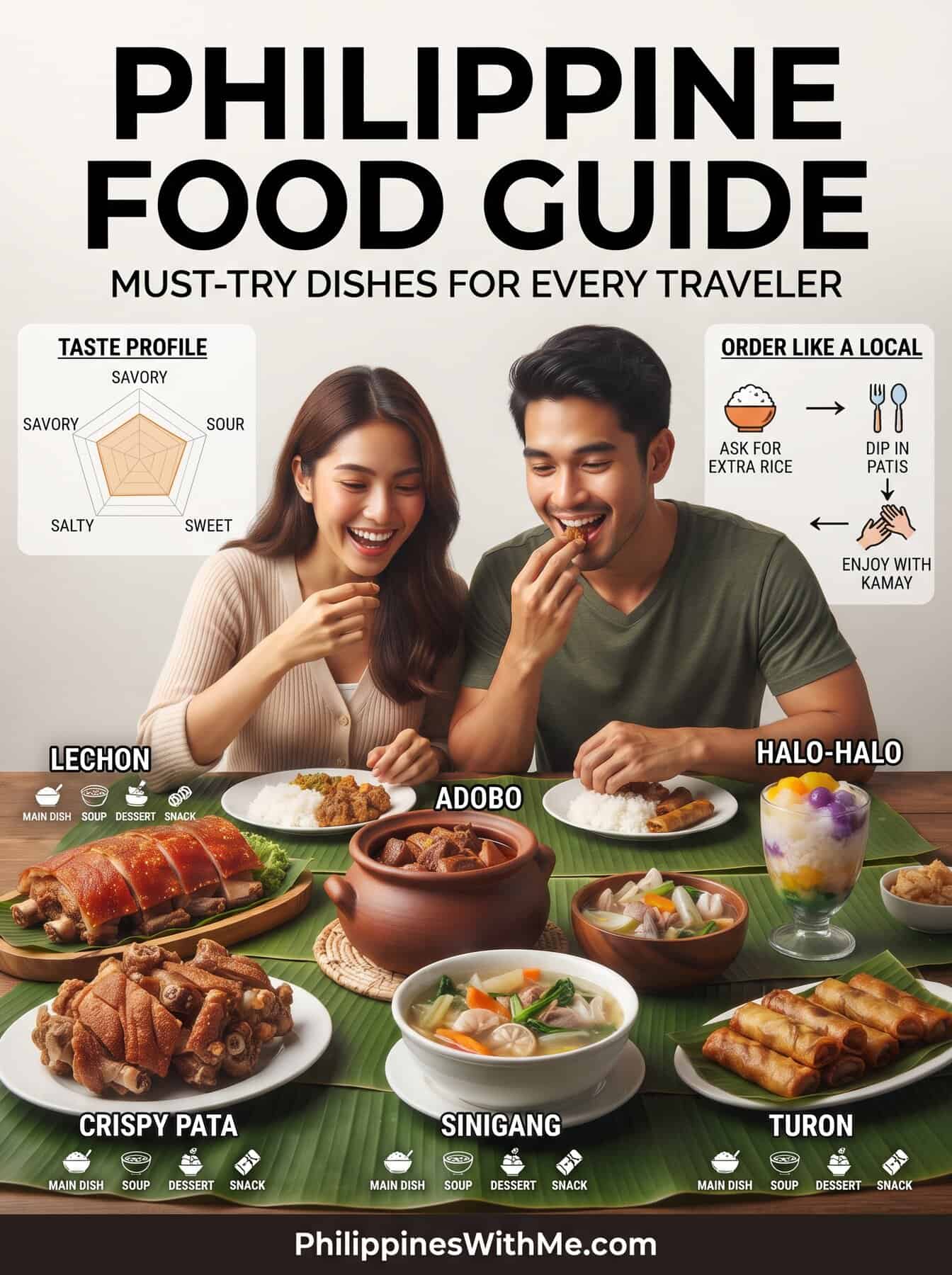
Filipino food is hearty, sour, salty, sweet and built for sharing. This guide explains what Filipino cuisine is and how it works, which dishes are worth seeking out, how to eat them, and how to stay comfortable while you do. It is less known abroad than its Southeast Asian neighbors, which is part of the fun: many visitors arrive with a vague idea of adobo and leave with a list of favorites they cannot find at home.
Top Filipino Foods at a Glance
| Dish | What it tastes like | Main ingredients |
|---|---|---|
| Adobo | Savory and tangy | Chicken or pork, vinegar, soy sauce, garlic |
| Sinigang | Sour and savory | Tamarind broth, pork, shrimp or fish, vegetables |
| Kare-kare | Rich, nutty and mild | Oxtail, peanut sauce, vegetables |
| Lechon | Crisp skin, rich | Roast whole pig |
| Sisig | Sour, rich and spicy | Chopped pork, calamansi, onion, chili |
| Pancit | Savory | Noodles, vegetables, meat or seafood |
| Lumpia | Crisp and savory | Spring roll wrapper, minced meat or vegetables |
| Halo-halo | Sweet and cold | Shaved ice, milk, beans, jellies, ube, leche flan |
| Tapsilog | Savory breakfast | Cured beef, garlic fried rice, egg |
| Champorado | Sweet and chocolatey | Sweet chocolate rice porridge |
| Bicol express | Creamy and spicy | Pork, coconut milk, chili |
| Kinilaw | Sour and fresh | Raw fish in vinegar or citrus |
What Is Filipino Food? How Filipino Cuisine Works
The easiest way to understand Filipino cuisine is to start with flavor. Dishes tend to balance sour, salty and sweet, with vinegar, calamansi, tamarind and green fruit supplying the sour; soy sauce and fish sauce or fermented shrimp paste supplying the salt; and sugar, coconut and sweet sauces supplying the sweet. Heat is usually milder than in much of Southeast Asia, although chili-forward cooking exists in some regions.
Rice is the anchor of nearly every meal. Dishes are often a rich, salty or sour viand meant to be eaten over plain steamed rice, and breakfast commonly means garlic fried rice with an egg and a cured or fried meat. Do not be surprised if a bowl of noodles arrives with rice on the side.
The cuisine reflects centuries of trade and colonization:
- Indigenous and Malay roots: cooking in coconut milk, grilling, steaming in leaves and souring with vinegar or fruit are old island techniques, as is eating fresh raw seafood in vinegar.
- Chinese influence: noodles, dumplings, soy sauce, tofu and the spring-roll family arrived through traders and settlers, and they remain central to everyday eating.
- Spanish influence: long colonial rule left roasted whole pigs, stews with tomato and sausage, rich festive dishes and many Spanish-derived dish names, along with sweets and baked goods.
- Later influences: American-era tastes brought canned and processed ingredients, and sweet spaghetti and fast-food culture are now part of the national table.
Popular Filipino Food: Must-Try Dishes
You will see these dishes on menus across the country. Versions differ from family to family and region to region, so treat each description as a general guide rather than a strict definition.
Adobo
Often described as the unofficial national dish, adobo is meat simmered in vinegar, soy sauce, garlic, peppercorns and bay leaf. It is savory, tangy and best with a lot of rice. Some cooks add coconut milk or let the sauce reduce until the meat browns. Adobo is closer to a cooking technique than a fixed recipe, so versions differ by region and household: some use coconut cream or milk, others add annatto (atsuete) for color or use more pepper and bay leaf.
Main ingredients: chicken or pork (sometimes both), vinegar, soy sauce, garlic, bay leaf.
Where to try it: almost any carinderia or home-style restaurant.
Dietary note: usually contains meat and soy; vegetable and tofu versions exist but need to be requested.
Sinigang
The classic sour soup. Sinigang is usually soured with tamarind and cooked with vegetables such as water spinach, radish, long beans and eggplant, plus pork, shrimp, fish or beef. If you like tangy broths, this is a comfort dish worth ordering early in your trip.
Main ingredients: tamarind or other souring agent, pork, shrimp, fish or beef, vegetables.
Where to try it: local restaurants and carinderias.
Dietary note: fish and shrimp versions are common, so check if you have a seafood allergy.
Kare-Kare
A stew of oxtail or other cuts and vegetables in a thick, peanut-based sauce, traditionally served with bagoong (fermented shrimp paste) on the side. The sauce itself is mild, so the paste is added a little at a time for salty depth.
Main ingredients: oxtail or beef, peanut sauce, vegetables, shrimp paste on the side.
Where to try it: local restaurants, especially for sharing at a family meal.
Dietary note: contains peanuts, and the shrimp paste is a shellfish allergen.
Lechon
Roast whole pig with crackling skin is the centerpiece of Filipino celebrations. Many regions claim a special version, and Cebu has a particularly strong reputation, covered in our guide to where to try Cebu lechon. Lechon is also sold by weight in markets and specialist shops, so you do not need a party to try it.
Main ingredients: whole pig, herbs and spices, sometimes lemongrass.
Where to try it: specialist lechon shops and markets, with Cebu the best-known place.
Dietary note: pork only, and rich; share it.
Sisig
Chopped pork, traditionally from the head and other cuts, seasoned with calamansi, onion and chili and often served sizzling on a hot plate, sometimes topped with a raw or cooked egg. It is rich and sour and is classic drinking food. It is closely associated with Pampanga, and menus now also offer chicken, seafood and tofu versions.
Main ingredients: pork, calamansi, onion, chili, often egg.
Where to try it: grill restaurants and bars, especially in Pampanga.
Dietary note: contains pork and often egg; tofu sisig is meat-free only if the cook leaves out fish sauce, meat stock and pork fat, so ask before you order.
Pancit
The general word for noodle dishes, from Chinese roots. Pancit canton uses egg noodles, pancit bihon uses thin rice noodles, and there are many local variations. Noodles are linked to long life, so pancit often appears at birthdays.
Main ingredients: noodles, vegetables, meat or seafood.
Where to try it: carinderias, bakeries and celebration tables.
Dietary note: contains wheat or egg in some versions; many contain shrimp or meat.
Lumpia
Filipino spring rolls. Lumpiang shanghai are thin, fried and filled with seasoned minced meat, usually served with a sweet-and-sour or sweet chili dip. Fresh and vegetable versions also exist. They are easy, cheap and everywhere.
Main ingredients: spring roll wrapper, minced pork or vegetables.
Where to try it: street stalls, carinderias and parties.
Dietary note: wrappers contain wheat; vegetable versions are widely available.
Halo-Halo
The signature dessert: shaved ice with milk and a jumble of sweet toppings, which commonly include beans, jellies, sweet fruit, leche flan and ube ice cream. The name means “mix-mix”, and the idea is to stir it all together before eating. It is a welcome break from the midday heat.
Main ingredients: shaved ice, evaporated milk, beans, jellies, fruit, ube, leche flan.
Where to try it: dessert shops, malls and local eateries.
Dietary note: contains dairy and sometimes egg.
Balut: An Honest Note
Balut is a boiled fertilized duck egg, eaten warm with salt or vinegar, and it is the dish foreigners most often hear about. It is a genuine local snack, usually sold by vendors in the evening, and plenty of Filipinos enjoy it. It is also not a must for everyone. If the idea does not appeal, nobody will think less of you for skipping it. If you do try it, buy it hot from a busy vendor and make sure it is fully cooked.
More Traditional Filipino Food Worth Knowing
- Kinilaw: raw fish or seafood cooked in vinegar or citrus with onion, ginger and chili, similar in spirit to ceviche. Raw fish carries a higher risk of stomach trouble even when it is fresh and cured in vinegar or citrus, so skip it if your stomach is sensitive and choose cooked seafood instead.
- Tinola: a gentle chicken soup with ginger, green papaya or chayote and leafy greens.
- Bulalo: a clear beef shank and bone-marrow soup from Southern Luzon, especially Batangas.
- Crispy pata: deep-fried pork knuckle with crackling skin, usually shared with a vinegar dip.
- Pinakbet: a vegetable stew often flavored with shrimp paste, associated with northern Luzon.
- Turon: fried banana and sweet jackfruit in a spring-roll wrapper, caramelized on the outside. A common street snack.
- Bibingka and puto bumbong: rice cakes associated with the Christmas season. Bibingka is baked, often with coconut and salted egg; puto bumbong is a purple steamed rice treat served with butter, sugar and coconut.
- Ube: the purple yam, used in ice cream, jam, cakes and halo-halo.
Filipino Breakfast Dishes
Breakfast is hearty and usually built around garlic fried rice and an egg. The classic format is the “silog”, a short name that joins sinangag (garlic fried rice), itlog (egg) and a meat, and you will see it on menus at carinderias, cafés and fast-food chains alike.
- Tapsilog: cured, thin-sliced beef with garlic fried rice and a fried egg.
- Longsilog: sweet, garlicky Filipino sausage (longganisa) with rice and egg.
- Tosilog: sweet cured pork (tocino) with rice and egg.
- Champorado: sweet chocolate rice porridge, sometimes eaten with a salty dried fish on the side for contrast.
- Pandesal: soft bread rolls, a classic bakery breakfast with coffee.
Most breakfast plates contain pork or beef, egg and rice, so vegetarians will find the best choice in egg-and-rice plates or bakery bread.
Filipino Food Desserts and Sweets
Filipino food desserts deserve a short stop. Beyond halo-halo and turon, look for leche flan (a dense caramel custard), ube-flavored sweets, and rice cakes such as bibingka and puto bumbong in the Christmas season. Merienda, the afternoon snack, is a real institution, and sweets are a good way to taste local ingredients like coconut and sticky rice.
Regional Filipino Food Worth Planning Around
Regional cooking rarely travels past its home island, so the best plan is to eat locally wherever you go. These are the well-known associations, not an exhaustive list.
- Cebu: famous for lechon, and a good base for tasting it. See the Cebu travel guide for the wider trip.
- Ilocos: known for garlicky, tangy longganisa sausages and the Ilocos empanada, especially in the Vigan area. The empanada is a fried turnover with an orange shell of rice flour colored with annatto, filled with shredded green papaya, mung beans, egg and longganisa, so it is not a vegetarian snack. It is cooked fresh in town plazas and markets and eaten with sukang Iloko, the local sugarcane vinegar. Our Vigan guide covers the heritage streets and food.
- Bicol: famous for cooking with coconut milk and plenty of chili. Bicol express, a spicy pork dish in coconut milk, is the headline example.
- Davao: a hub for tropical fruit, especially durian and pomelo. The Davao guide covers the city and surroundings.
- Pampanga: widely called the culinary capital of the Philippines, and the home of sisig and many of the country’s celebrated cooks.
In Manila, regional cooking from all over the country converges, so it is easy to sample many styles in a single weekend. The Manila travel guide is a good starting point, and our guide to Manila street food goes deeper on snacks. Many dishes tie to local celebrations, so see the festival calendar if you want to time a trip around them.
Filipino Dishes by Region and Main Ingredient
| Dish | Region | Main ingredient | Best for |
|---|---|---|---|
| Adobo | Nationwide | Chicken or pork, vinegar | A first taste of Filipino cooking |
| Sinigang | Nationwide | Tamarind, pork or shrimp | A sour, comforting soup |
| Kare-kare | Luzon | Oxtail, peanuts | A rich shared meal |
| Lechon | Cebu and nationwide | Whole roast pig | Celebrations and special meals |
| Sisig | Pampanga | Chopped pork | Drinking food |
| Pancit | Nationwide | Noodles | Birthdays and everyday meals |
| Lumpia | Nationwide | Wrapper, meat or vegetables | Cheap snacks |
| Halo-halo | Nationwide | Shaved ice, beans, ube | Cooling off in the heat |
| Bicol express | Bicol | Pork, coconut milk, chili | Spicy food lovers |
| Longganisa | Ilocos and nationwide | Sausage | Breakfast |
| Pinakbet | Northern Luzon | Vegetables, shrimp paste | Vegetable dishes |
| Kinilaw | Visayas and Mindanao | Raw fish, vinegar | Fresh seafood |
| Tinola | Nationwide | Chicken, ginger | A light soup |
| Bulalo | Southern Luzon (Batangas) | Beef shank, marrow | Cool weather |
| Crispy pata | Nationwide | Pork knuckle | Sharing |
| Turon | Nationwide | Banana, jackfruit | Street snacks |
| Bibingka | Luzon, Christmas season | Rice, coconut | Seasonal treats |
| Puto bumbong | Luzon, Christmas season | Purple rice | Seasonal treats |
| Tapsilog | Nationwide | Beef, rice, egg | Breakfast |
| Champorado | Nationwide | Rice, chocolate | Sweet breakfast |
How to Eat Filipino Food Like a Local
Filipino food is generally enjoyed in a relaxed, communal way. The usual utensils are a fork and a spoon, not a knife: the spoon is held in the right hand and the fork pushes food onto it. Meals are served family-style, with dishes in the middle and everyone taking a portion over rice. Ordering several dishes to share is the norm, and it is the best way to taste more of the menu.
You may also encounter kamayan, eating with the hands, typically from a spread of rice, grilled meat and seafood laid out on banana leaves. Wash your hands first, use your right hand and follow the people around you. Restaurants offer kamayan as an experience, and many families eat this way at home.
Hosts will often urge you to keep eating Filipino food, and politely refusing a first offer is normal. Lunch and dinner are leisurely, snacks (merienda) in the afternoon are a real institution, and you will rarely go hungry.
Filipino Food Culture: Types of Places to Eat
| Type | What it is | Best for |
|---|---|---|
| Carinderia | A small, casual eatery with pots of home-style dishes served with rice | Cheap, everyday local food |
| Turo-turo | “Point-point”: you point at the dishes you want from the counter | Easy ordering without a menu or shared language |
| Street food | Grilled skewers, fried snacks, fruit and sweets from carts and stalls | Quick snacks and evening wandering |
| Local restaurant | Sit-down places serving regional specialties and sharing platters | Celebration dishes such as lechon or kare-kare |
| Mall food courts and fast-food chains | Air-conditioned, with local fast-food brands as well as global ones | Midday heat, families, reliable bathrooms |
Carinderias and turo-turo spots are the most direct way to taste everyday Filipino food. Look for places that are busy with locals, as high turnover means fresher food. For how food fits into a daily budget, see our money guide and the daily budgets for every travel style.
For a sit-down meal, the MICHELIN Guide covers Manila and its surrounding area and Cebu. Its first Philippine selection listed 108 restaurants, including 25 Bib Gourmand restaurants (19 in Manila and environs, 6 in Cebu), a distinction for exceptional food at moderate prices. Not every listed restaurant serves Filipino cooking, but the Bib Gourmand list is a handy shortlist when you want a proper restaurant meal without fine-dining prices.
Filipino Food Dietary Notes
- Pork is everywhere. Adobo, sisig, lechon, crispy pata and many soups use pork or pork fat, and meat is often used as a flavoring even in vegetable dishes.
- Vegetarian options are limited but possible. Vegetable dishes such as pinakbet and ginataang (coconut milk) vegetable dishes may be cooked with shrimp paste or meat, so ask. Tofu, eggplant dishes, fresh fruit and rice are easy fallbacks. Larger cities and tourist areas tend to have more vegetarian and vegan restaurants.
- Halal food is available in places. Halal options exist, particularly in areas with Muslim communities such as parts of Mindanao and in some Manila neighborhoods and malls. Availability is uneven, so check venues and certifications individually.
- Allergies: fish sauce, shrimp paste, peanuts (in kare-kare), shellfish and eggs are common. Learn the local words for your allergens and confirm directly, since English menus do not always list ingredients.
What to Drink with Filipino Food
- San Miguel: the country’s best-known beer brand, sold nearly everywhere. Local craft beer is growing in larger cities.
- Tuba: fermented coconut palm sap, a traditional local drink, usually sold at village level. Quality varies, so be cautious.
- Calamansi juice: a small, sour citrus served as a juice or squeezed over dishes. It is refreshing in the heat.
- Coffee: the Philippines grows coffee, with highland areas notable for it, and there is a lively café scene in cities and tourist spots.
- Other: fresh buko (young coconut) juice, sago-and-gulaman sweet drinks and fruit shakes are widely sold.
Eating Filipino Food Safely While Traveling
Most visitors enjoy Filipino food without trouble, but a few sensible habits help. For broader safety tips, see is the Philippines safe for tourists.
- Choose busy stalls and restaurants with high turnover, and prefer food that is hot, freshly cooked and served immediately.
- Be cautious with raw seafood, ice of uncertain origin and anything that has been sitting out in the heat. Food from street vendors carries more risk than a restaurant kitchen, and fully cooked food served hot is the safest choice. If you are not sure how the ice was made, ask for the drink without it.
- Drink bottled or purified water, and ask about the source of ice in drinks if you are unsure. Many city restaurants use commercially produced ice.
- Wash or sanitize your hands before eating, especially before kamayan or street snacks.
- Ease in. Rich, oily food can be a lot at once, so pace yourself during the first days.
- Carry basic stomach medicine and rehydration salts, and see a doctor if symptoms are severe or persist.
A Simple Plan for Trying Filipino Food
Few travelers have time to taste everything, so here is a practical way to pace your Filipino food trip. Begin in Manila for variety, taking in carinderias, street snacks and a sit-down restaurant meal. Move on to the Visayas for lechon and seafood, and head to island beach destinations such as Boracay for grilled fish, fresh fruit shakes and relaxed beach dining. If you travel south, add Davao for fruit. Eat the regional dish wherever you are, and keep one meal for a family-style feast you can share. For a full route, see the ten-day itinerary, and for how the food compares with Vietnam, see Philippines versus Vietnam.
Frequently Asked Questions About Filipino Food
What is the national dish of the Philippines?
There is no official single national dish in everyday usage, but adobo is the one most often given that title. Sinigang and lechon are also strong contenders.
What is Filipino food known for?
Balanced sour, salty and sweet flavors, hearty dishes served with rice, and a mix of Malay, Chinese and Spanish influences, with strong regional variety.
Is Filipino food spicy?
Generally not very. Most dishes lean sour, salty and savory, with chili served on the side or used lightly. Some regions, especially Bicol, cook with far more heat.
What do Filipinos eat for breakfast?
Typically garlic fried rice with an egg and cured or fried meat, known as silog dishes such as tapsilog, longsilog and tosilog. Champorado and pandesal are other common breakfasts.
Do I have to eat balut?
No. It is a local snack that some people love and others avoid. It is fine to skip it, and nobody expects visitors to try it.
Can vegetarians eat well in the Philippines?
It takes some care. Many dishes contain meat, fish sauce or shrimp paste, so ask how things are cooked. Cities and tourist areas have more choices, and fruit, rice, tofu and vegetable dishes help elsewhere.
Is street food safe?
Many visitors enjoy it without problems. Choose busy vendors, eat food that is freshly cooked and hot, and avoid anything that looks like it has been sitting out.
Do Filipinos eat with their hands?
Sometimes. A fork and spoon are standard at most meals, while kamayan, eating by hand, is a traditional style found at special meals and some restaurants.
Which Filipino dishes should I try first?
Start with adobo, sinigang and halo-halo, add one regional dish in every place you visit, and treat balut as optional.
Bottom Line: Filipino Food
For anyone planning to try Filipino food, come hungry, order to share, and let rice carry the flavors. Start with adobo, sinigang and halo-halo, add one regional dish in every place you visit, and treat balut as optional. Keep your food-safety habits sensible, and you will find that eating is one of the most rewarding ways to understand the country.