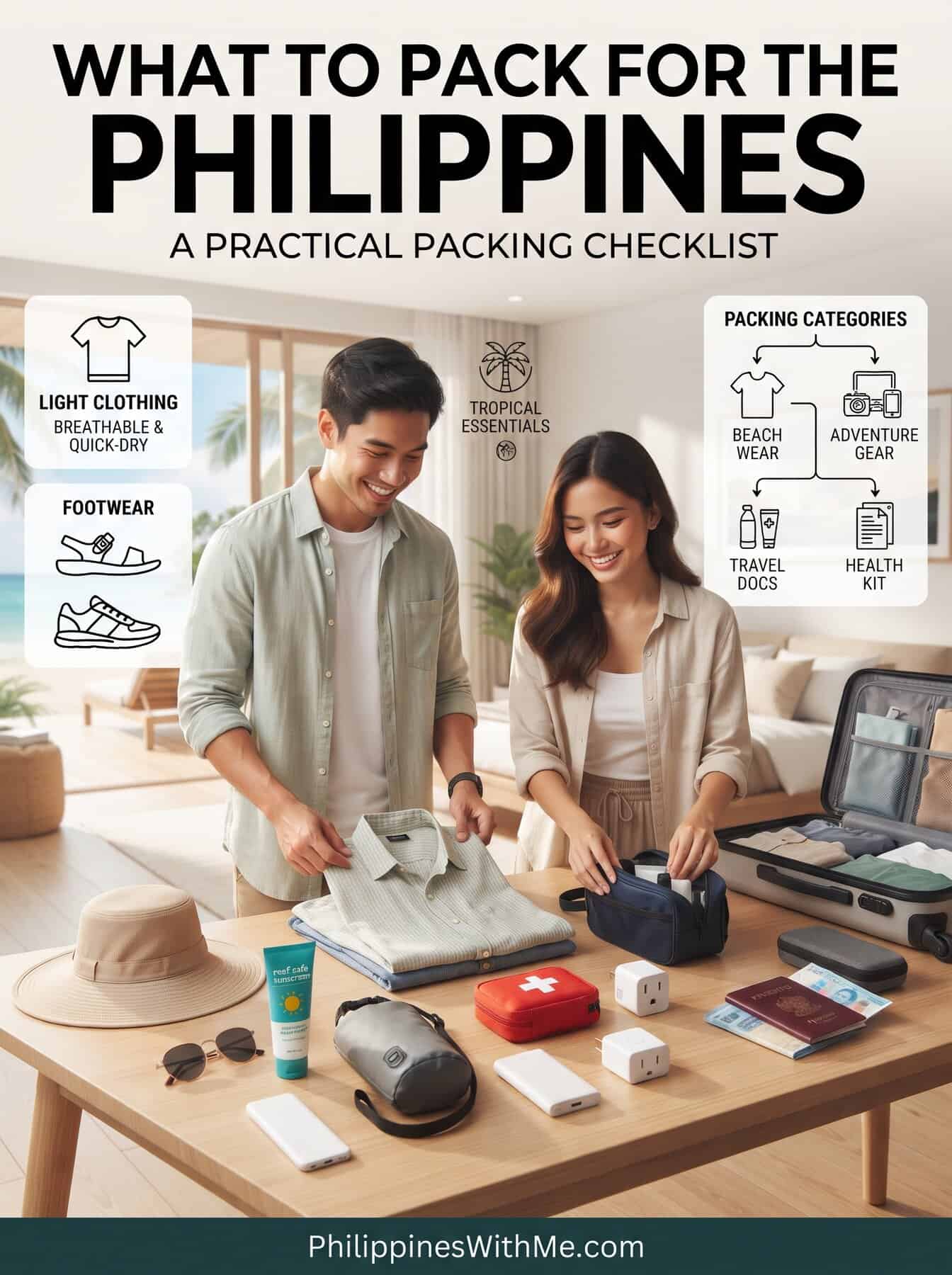
Quick answer: Pack for heat, humidity and sudden heavy rain: the rainy season runs from June to November and the dry season from December to May. Add a dry bag, rash guard and water shoes for island hopping, and a fleece or light jacket with long trousers for highlands such as Baguio and Sagada.
Knowing what to pack for the Philippines comes down to three realities: it is hot and humid for most of the year, it rains hard when it rains, and you will probably move between air-conditioned malls, open-sided boats, jeepneys and sandy beaches in a single week. This guide gives you a category-by-category checklist, then adds regional extras for the highlands, islands, dive sites and the capital, so you can pack light without arriving short of anything important.
What to Pack for the Philippines: Start With the Trip
Not sure when to go? See our best time to visit the Philippines guide. Two decisions shape everything else: when you travel and where you go. The wet and dry seasons differ across the archipelago, so read our guide to the best time to visit the Philippines before you finalize your list. Nationally, the rainy season runs from June to November and the dry season from December to May. A dry-season beach trip needs sun protection and swimwear first; a wet-season trip needs rain layers, quick-drying fabrics and waterproof storage first. Either way, plan on fewer clothes than you think. Laundry is cheap and easy to find in most tourist areas, and everything you wear will dry quickly if you choose the right fabrics. A sensible target for a two-week island trip is a carry-on plus a small daypack, or one modest checked bag. Domestic flights, ferries and vans all reward light luggage, and many small island transfers involve carrying your own bag across sand or a boarding plank.
Clothing for Heat and Humidity
Clothing is usually the biggest category in what to pack for the Philippines, so start here. Choose lightweight, breathable, quick-drying pieces. Cotton is comfortable but slow to dry in humid air; linen, rayon blends and technical synthetics dry faster and feel better when you are sweating. Light colors show less heat, but darker prints hide sweat and stains better, so a mix works.
- Tops: 5 to 7 breathable T-shirts or tank tops, plus one or two collared or nicer tops for dinners and city outings.
- Bottoms: 2 to 3 pairs of lightweight shorts, one pair of light long trousers or a long skirt for temples, churches and air-conditioned venues, and one pair of lightweight hiking or travel pants if you plan to trek.
- Underwear and socks: Pack enough for a week, since you will sweat more than at home. Moisture-wicking underwear is worth the space.
- Sun hat or cap: Brimmed hats protect your face and neck on boat days. Add a lanyard or clip if you will be on open boats where wind can take it.
- Sunglasses: Polarized lenses help in glare off the water.
Dress norms are relaxed on the beach and in resort areas, but are more conservative in churches, government offices and smaller towns. Bring a light scarf or sarong that covers shoulders or knees on short notice; it also doubles as a beach wrap, picnic blanket or sun cover. For shoes, bring sturdy sandals, light trainers for city walking and trails, and water shoes for coral rubble and slippery rocks. Skip leather and suede, which suffer in humidity.
Rain Gear and Waterproofing
Even outside the rainy months, short heavy showers can arrive quickly. A compact, packable rain jacket or poncho is more useful than an umbrella on windy boat rides, although a small travel umbrella is handy in cities. A waterproof cover for your daypack and a few zip-top bags protect passports, phones and chargers. A dry bag is one of the best-value items on the list. Island hopping and river trips often involve splashes, spray and wet landings, and boat operators typically provide limited protection for your belongings. A 10 to 20 liter dry bag keeps your phone, wallet and a change of clothes dry. Also consider a waterproof phone pouch that you can wear around the neck when you swim or board small boats.
Swimwear, Rash Guard and Water Gear
- Two swimsuits or board shorts: Having a dry one to change into saves a lot of discomfort on multi-day trips.
- Rash guard: A long-sleeve UV-protective rash guard covers your back and arms during long snorkeling sessions, and reduces how much sunscreen you need to apply and wash into the water.
- Quick-dry towel: Many budget stays and boat tours do not supply towels, and regular towels stay damp for a long time in humid weather.
- Snorkel mask: Optional. Rental gear is widely available, but a mask that fits your face well makes the experience better, and some travelers prefer to bring their own for hygiene.
- Waterproof camera or phone case: Useful for snorkeling and kayaking.
Sun Protection and Reef-Safe Sunscreen
The tropical sun is strong year-round, including on overcast days. Pack a high-SPF, broad-spectrum sunscreen, lip balm with SPF and after-sun lotion or aloe. Bring more than you expect to need; sunscreen is available in cities and tourist hubs, but selection can be limited and prices on small islands can be higher. If you will be swimming near coral, choose a mineral-based or clearly labeled reef-friendly product where possible, and apply it well before you enter the water. Some marine sanctuaries, protected areas and local governments restrict or discourage certain sunscreen ingredients or require you to cover up with a rash guard instead. Rules differ by location and change over time, so check with your tour operator or the local tourism office before you go, and treat a rash guard as the most reliable solution.
Insect Repellent and Health Basics
For broader safety tips, see Is the Philippines safe for tourists?. Mosquitoes are present in many parts of the country, particularly around dusk and in wet or vegetated areas. The mosquitoes that spread dengue bite during the day, so apply repellent in the morning and afternoon as well as in the evening. Pack insect repellent that you are comfortable using on skin (look for DEET, picaridin or IR3535 on the label), and consider lightweight long sleeves for evenings. For health advice specific to your home country and itinerary, including any vaccinations or malaria and dengue guidance for the areas you will visit, consult a travel clinic or your national health authority before departure. We cannot give medical advice, and requirements can change.
First-Aid and Medication Kit
- Any prescription medication in its original packaging, with enough for the whole trip plus a few spare days, and a copy of the prescription or a doctor’s letter for anything controlled.
- Oral rehydration salts, anti-diarrhea medication and basic stomach remedies.
- Pain relievers and fever reducers, plus antihistamines for bites or allergies.
- Bandages, blister pads, antiseptic wipes or cream and a small roll of tape. Coral cuts and sandal blisters are common.
- Motion-sickness tablets if you are prone to it; small boats and winding mountain roads can be rough.
- A basic thermometer, hand sanitiser and any personal items such as contact-lens supplies.
Pharmacies are easy to find in cities and larger towns, but remote islands may have limited stock. Do not count on buying specialist medication on arrival.
Electronics, Power and Plug Adapters
For staying connected, see our Philippines SIM card guide. The Philippines generally uses around 220 to 230 volts and sockets that commonly accept Type A, B and C style plugs (flat two-pin, flat two-pin with a ground pin, and round two-pin). Many sockets are flexible enough to take more than one type, but this varies by building, and some older rooms have worn or loose sockets. The frequency is 60 Hz. Look at the label on each charger: most phone and laptop chargers are rated for 100 to 240 volts and need only a plug adapter here. Hair dryers, straighteners and shavers built for 110 to 120 volts are the problem: North American plugs often fit the sockets, but the higher voltage can burn the appliance out, so leave single-voltage devices at home or bring a converter.
- Universal travel adapter: The safest single purchase. Pick one with USB ports so that you need fewer plugs.
- Power bank: Useful on long ferry or van rides and during power cuts, which can happen on smaller islands. Airlines require lithium batteries and power banks in carry-on, not checked luggage, so keep yours in your cabin bag. Power banks up to 100 Wh go in the cabin without approval (a 20,000 mAh bank is about 74 Wh), 100 to 160 Wh units need airline approval at check-in, and larger ones are not allowed on board. Cebu Pacific also bans using or charging a power bank during the flight and wants it in your pocket or the seat pocket, not in the overhead bin.
- Short extension strip or multi-port charger: Rooms can have only one usable outlet.
- Offline maps and a phone SIM plan: See our guide to SIM cards and eSIMs in the Philippines for connectivity options so that you can arrive with data ready.
- Camera, spare memory cards and a lens cloth. Humidity fogs lenses, so give them time to adjust when moving between air-conditioned rooms and outdoors.
Drones are subject to rules and sometimes permits, and are restricted in some protected or sensitive areas. Under CAAP rules, recreational drones under 7 kg need no registration, but flying at night, beyond visual line of sight, above 400 feet, over populated areas or within 10 km of an airport requires a special flight permit.
Documents, Money and Cards
For currency and ATM tips, see Money in the Philippines: currency, ATMs and daily costs.
Documents
- Passport: Check validity well before you book. For visa-free entry, the passport must be valid for at least six months beyond your planned stay, and the airline looks at the expiry date at check-in.
- Visa and onward ticket: Entry rules depend on your nationality. Our Philippines visa guide covers the details. Most visa-free nationalities get an initial 30 days, Brazilian and Israeli passport holders get 59 days, and Chinese and Indian nationals have separate 14-day visa-free schemes with extra conditions (Indians with a valid US, Japanese, Australian, Canadian, Schengen, Singapore or UK visa get 30 days). Carry proof of onward or return travel, as airlines may ask for it at check-in.
- Arrival or health declaration: The Philippines asks arriving travelers to register on the free online eTravel portal, generally within 72 hours before arrival. Registration is free on the official eTravel site (etravel.gov.ph), so close any lookalike site that asks for a fee, and have the confirmation ready to show before you board. Save the QR code or confirmation offline.
- Travel insurance: Choose a policy that covers medical care, evacuation, and activities such as diving, plus trip disruption in typhoon season.
- Copies: Keep photos of your passport, insurance, bookings and prescriptions in cloud storage and offline on your phone, and one paper set separate from the originals.
- Dive certification card: Bring it if you plan to dive.
Cash and cards
Cards are accepted in malls, larger hotels and many restaurants, but small islands, markets, tricycles, boats and local eateries are largely cash-based. Carry a mix of small notes in Philippine pesos, and a card with low foreign-transaction fees plus a backup card stored separately. Our guide to money in the Philippines covers currency, ATMs and typical costs in detail. Bring a small waterproof pouch or money belt for valuables on boat days.
Regional Add-Ons
The table below rounds out what to pack for the Philippines once you add a specific region to the mix.
| Destination type | Add to your pack | Why |
|---|---|---|
| Highlands (Baguio, Sagada) | Warm fleece or light jacket, long trousers, closed shoes, socks, a rain layer | Elevation makes evenings and mornings noticeably cool |
| Island hopping (Palawan, Boracay, Cebu islands) | Dry bag, rash guard, water shoes, quick-dry towel, motion-sickness tablets | Wet landings, sun exposure and small boats |
| Diving and snorkelling | Certification card, logbook, personal mask, reef-safe sunscreen, dive computer if you own one | Operators rent gear, but personal fit and records matter |
| Surfing (Siargao, La Union) | Rash guard, reef booties, reef-safe sunscreen, board wax, leash | Reef breaks and strong sun; boards are usually rentable |
| Hiking and waterfalls | Trail shoes with grip, light long sleeves, headlamp, refillable bottle, insect repellent | Slippery trails, leeches or mosquitoes in some forest areas, early starts |
| Manila and other cities | Light layer for strong air conditioning, comfortable walking shoes, small anti-theft bag | Heat outdoors and cold interiors; crowded transport |
Highland towns such as Baguio and Sagada are far cooler at night than the coast, so bring a warm layer and shoes with good grip. Baguio sits at about 1,500 meters and has a mean annual temperature of 18.3°C, compared with a lowland average of 26.6°C.
Island hopping and beach destinations
If you are heading to a classic beach destination such as Boracay, the core kit is swimwear, rash guard, sunscreen, a hat, flip-flops and a dry bag. Beachfront dining is relaxed, but pack one smarter outfit for evenings. For boat days, bring a small towel, snacks and enough water for the day, plus cash for environmental or entrance fees that some sites collect on arrival. Surfers heading to Siargao, and divers anywhere, can rent most gear locally, so bring personal items such as a rash guard, reef booties, a mask and your certification card. Check airline baggage rules before taking a board bag or heavy dive kit. Hikers need shoes with real grip, and in cities a thin layer helps against strong air conditioning.
What Not to Bring, and What to Check First
- Excess clothes and heavy shoes: They are bulky and slow to dry. Laundry is cheaper than overweight baggage.
- Valuable jewelry and flashy watches: They attract attention and are easy to lose to the sea. Leave them at home.
- Single-use plastics: Many places discourage or restrict them. A refillable bottle, tote bag and reusable cutlery are practical choices. Check whether your accommodation has refill stations, and note that tap water is not generally treated as drinkable by visitors, so ask locally.
- Restricted or regulated items: Rules on e-cigarettes and vapes, drones, certain medications, firearms and knives, wildlife products and some food or plant items differ from country to country and change over time. Check the official sites of the Philippine authorities and your airline before you pack anything in these categories.
- Lithium batteries in checked bags: Keep them in your carry-on, as airlines require.
- Chemical sunscreens at protected sites: As noted above, some sanctuaries restrict ingredients. Ask first.
- Anything you cannot bear to lose: Humidity, salt and rough boat handling are hard on gear.
Luggage Choices for Boats, Vans and Planes
A soft duffel, a convertible backpack or a small wheeled soft-sided bag usually works better than a large hard-shell case. Boats, tricycles and vans have limited space and uneven loading, and sandy or cobbled paths are tough on small suitcase wheels. A backpack with a rain cover is the most flexible option for island hopping; a wheeled carry-on suits city-based trips and resorts with paved paths.
- Daypack (15 to 25 liters): For water, sunscreen, a dry bag, a rain layer and your valuables.
- Packing cubes: They keep damp and clean items separate and make repacking quick.
- Small padlocks: Handy for hostel lockers and luggage zips.
- Space for souvenirs: Leave room or pack a foldable bag for the trip home.
Domestic airlines can have stricter and different baggage allowances than international flights, and budget carriers often charge for checked bags or enforce weight limits on carry-ons. Check your airline’s current allowance before you pack, and weigh your bag at home.
Free Cabin Baggage on Domestic Airlines
| Airline | Free cabin allowance | What it covers |
|---|---|---|
| Cebu Pacific (5J flight numbers) | 10 kg in total | One overhead bag up to 56 x 36 x 23 cm plus one personal item up to 20 x 20 x 35 cm, wheels and handles included; the 10 kg limit applies to flights from September 15, 2026 |
| Cebgo (DG flight numbers on a Cebu Pacific booking) | 7 kg in total | Lower limit on Cebu Pacific’s regional flights; the flight number on your itinerary shows which one you are on |
| Philippine Airlines | 7 kg | One carry-on piece |
| AirAsia Philippines | 7 kg | One cabin bag plus one small personal item |
What to Pack for the Philippines in Typhoon Season
For what to expect, see our guide to Philippine typhoon season. If your travel dates fall in the wetter months, especially the July to October typhoon peak, plan for disruption as well as rain. Our guide to typhoon season in the Philippines explains how storms affect travel. From a packing perspective:
- Pack a good rain jacket, a waterproof bag or liner for your backpack and spare dry clothes in sealed bags.
- Carry a power bank, a small flashlight or headlamp, and any essential medication in your hand luggage in case you are delayed.
- Bring a little extra cash, since ATMs and card machines can fail in storms or power cuts.
- Keep copies of documents and insurance details accessible offline.
- Build buffer time between ferries and flights, and avoid packing items that would be ruined by a soaking.
- Follow official weather updates from PAGASA, the national weather agency, and listen to local advice.
Laundry on the Road
Packing light works because laundry is easy. Most towns popular with visitors have per-kilo laundry shops, and many guesthouses can arrange a wash. Ask about turnaround time before you hand over clothes, especially in the rainy season, when drying can take longer. For small washes, bring a few clothes pegs or a short travel line, a small tube of travel detergent and a few zip-top bags for damp items. Quick-drying fabrics can dry overnight in a ventilated room, but thicker cotton can stay damp for days.
Frequently Asked Questions
Quick answers on what to pack for the Philippines, asked most often.
What should I pack for the Philippines in the rainy season?
Bring a lightweight rain jacket or poncho, quick-drying clothes, a dry bag, waterproof covers for electronics and a pair of shoes that can get wet. Pack spare dry clothes in sealed bags, and keep key items in your hand luggage in case flights or ferries are delayed.
Do I need a power adapter for the Philippines?
Possibly. The country generally uses 220 volts and sockets that commonly take flat two-pin and round two-pin plugs (Types A, B and C). UK and Australian plugs need an adapter, and grounded three-pin plugs may not fit older two-slot sockets. A universal adapter and a charger rated for the local voltage cover most situations.
Can I buy things after I arrive?
Yes, in cities and major tourist hubs you can buy toiletries, clothing, sunscreen, repellent and basic medication. Selection is narrower and prices can be higher on small islands, and sizes or specific brands of medication may not match what you use at home, so bring essentials.
Is reef-safe sunscreen required?
Not everywhere, but some marine protected areas and local governments restrict or discourage certain ingredients. Check with your tour operator or the local tourism office. A UV rash guard is the simplest way to reduce how much sunscreen you need.
How much cash should I carry?
Enough for small islands, boats, markets and local meals, where cards are often not accepted. See our money guide for how to plan this, and keep a backup card separate from your main wallet.
Do I need warm clothes?
Mostly not, except for highland areas such as Baguio and Sagada, where evenings are cool, and for strongly air-conditioned buses, malls and cinemas. A thin fleece or long-sleeve layer is enough.
Bottom Line: What to Pack for the Philippines
For most trips, a light, quick-drying wardrobe, rain protection, a dry bag, reef-conscious sun care, insect repellent, a basic medical kit and the right plug adapter will cover nearly everything. Add region-specific items for the highlands, dive sites or surf breaks, check entry paperwork and restricted items on official sites, and leave space for laundry and souvenirs. Pack for humidity, water and long transfers, and the rest is easy to sort out on the ground.