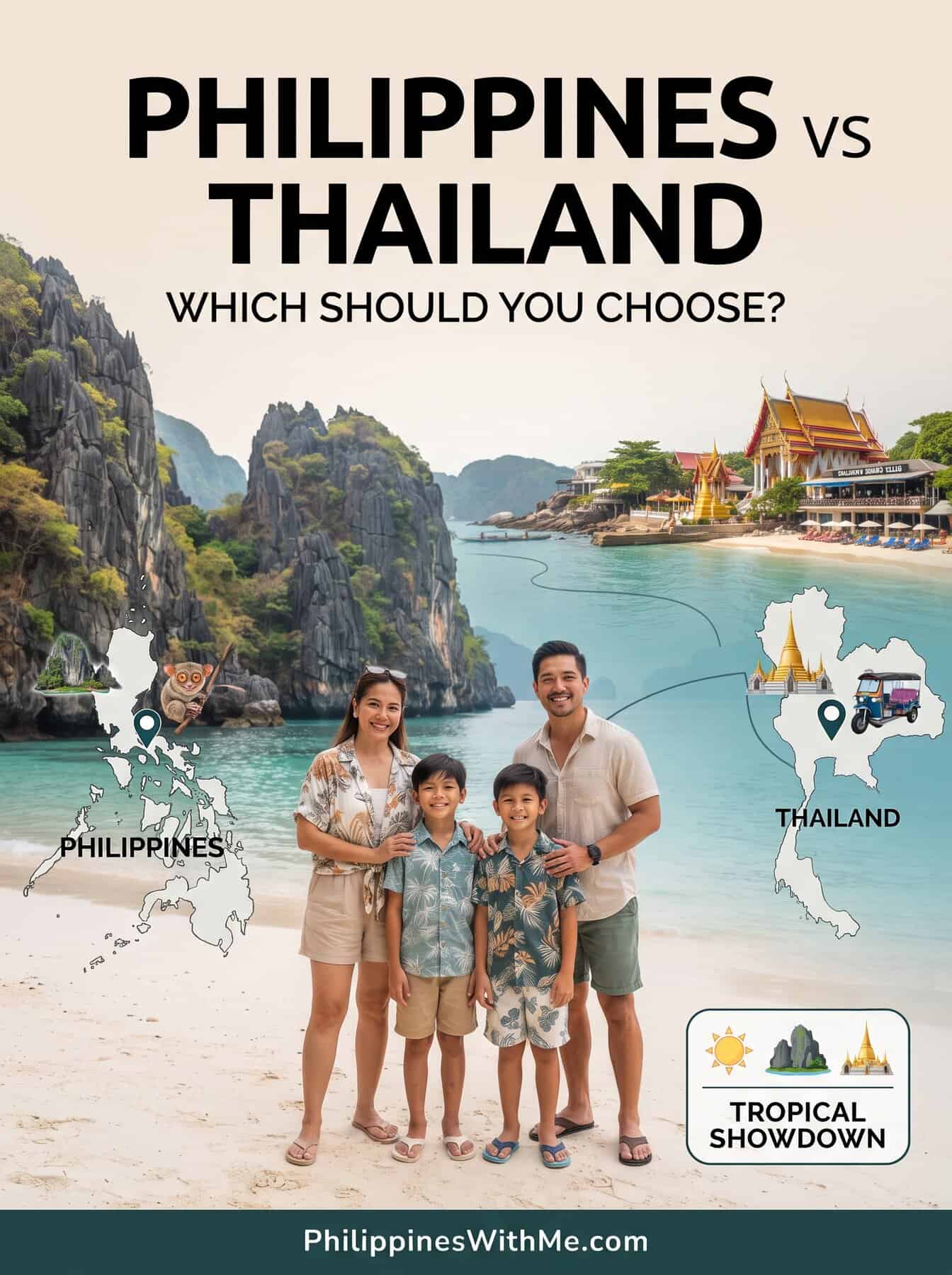
Both countries sell the same dream of warm water, limestone cliffs and cheap beachside dinners, so the question of Philippines vs Thailand comes up on almost every Southeast Asia planning thread. The honest answer is that they are good at different things. Thailand is a country you can fill with temples, night markets, trains, cooking classes and nightlife, with beaches as one chapter among many. The Philippines is an island country first: its best days are spent on boats, in lagoons and underwater. This guide compares them on beaches, cost, ease of travel, entry rules, season, food and infrastructure, and finishes with who should pick which. If you are weighing other neighbours too, our Philippines vs Indonesia comparison uses the same approach.
The Short Version
- Choose the Philippines for less-developed island scenery, lagoon and cliff island hopping, easy English, diving and a slower pace.
- Choose Thailand for variety beyond the sand: Bangkok, Chiang Mai, temples, a huge food scene, wellness and nightlife, plus a dense network of ferries, buses and trains.
- Choose both only if you have three weeks or more; the two are separated by a flight, and each rewards time rather than a rushed tick-list.
Several travel comparison sites reach a similar verdict: Thailand pulls ahead on everything that is not the beach, while the Philippines is the pick for slow travel, offbeat islands and natural immersion. We agree with that framing, with a few caveats below.
Beaches and Islands
Philippines
The Philippines is made of more than 7,000 islands, and the best of them are concentrated in a handful of regions. Palawan is the headline act, with limestone karst, hidden lagoons and white beaches around El Nido and Coron; our Palawan guide explains how the pieces fit together. Boracay offers a famous long white beach with resort infrastructure, Siargao is the surf island, and the Visayas have sandbars, whale-shark and sardine encounters and quieter small islands. Travel writers regularly place El Nido, Coron and Siargao among the best beach destinations in Southeast Asia, and note that many Philippine beaches feel less crowded and less built-up than the most famous Thai ones. For a ranked tour of the options, see our guide to the best islands in the Philippines, and for the classic two-way decision, Boracay vs Palawan.
Thailand
Thailand’s beach story is split across two coasts. On the Andaman side you find Phuket, Krabi, Phi Phi and Koh Lipe, with dramatic limestone scenery and long-tail boats. In the Gulf are Koh Samui, Koh Phangan and Koh Tao, which is a diving-training hub. Thailand’s beaches range from lively resort strips with nightlife and water sports to quiet corners such as Koh Lipe that still have clear water. The trade-off is that the best-known islands, especially on the Andaman coast, are busy, and you often need to go further afield or off-season to find solitude.
Verdict
If the single most important criterion is the most beautiful, least-developed island scenery, the Philippines usually wins. If you want a beach holiday that also comes with a choice of resorts at every price, bars, and plenty to do on a rainy afternoon, Thailand wins. Neither is wrong; they are different products.
Cost: Closer Than You Might Think
For a detailed daily breakdown, see Philippines travel cost: daily budgets for every style. The Philippines vs Thailand cost question is close enough that the common assumption is worth checking: many assume Thailand is much cheaper. Comparisons that line the two up find they are very close. Mid-range travel in both countries is commonly put somewhere in the broad band of fifty to ninety US dollars a day per person, with the Philippines marginally cheaper for hotels in some estimates and Thailand marginally cheaper for everyday meals. Treat any single figure as indicative, because prices move with the season and the exchange rate. Where the two genuinely differ is in the shape of the spending:
- Food: Thai street food is famously cheap and plentiful, and a small meal from a stall costs very little. In the Philippines, carinderia (local canteen) meals are cheap too, but options in tourist islands lean toward restaurant prices.
- Accommodation: Both have hostels and guesthouses at low prices. The Philippines tends to be good value away from Manila and Boracay, while Thailand’s dense market keeps competition high everywhere.
- Getting between places: This is the biggest difference. Thai islands are linked by ferries, buses and trains, so multi-stop trips are cheap. Philippine islands are mostly connected by flights or longer ferries, so an island-hopping itinerary costs noticeably more.
Our money guide covers currency, ATMs and typical daily costs in the Philippines, and the Philippines travel budget guide breaks the numbers down by travel style so you can compare them against your Thai estimate.
Ease of Travel and Language
English is the Philippines’ trump card. It is an official language alongside Filipino, signage and menus are in English, and almost everyone you deal with in tourist areas can help you in it. In Thailand, English is common in resorts and tourist hubs, but outside them you will rely on translation apps and gestures. For first-time travellers or anyone travelling alone, this removes a lot of friction in the Philippines. Thailand counters with sheer maturity. The tourism infrastructure is deep: you can book a bus, minibus, ferry or sleeper train in advance, find a clear choice of tours at every price, and move between destinations with little planning. In the Philippines, distances between top destinations are often bridged by a domestic flight, schedules can change with weather, and some transfers (for example, between the main Palawan towns) are long by road. None of this is a problem if you build slack into the itinerary, but it rewards planning more than Thailand does.
| Factor | Philippines | Thailand |
|---|---|---|
| Beach character | Karst lagoons, small islands, fewer crowds in many places | Developed resort strips plus a few quiet islands |
| Beyond the beach | Diving, island hopping, waterfalls, a few cities | Bangkok, Chiang Mai, temples, markets, nightlife |
| English | Widely spoken | Common in tourist areas, limited elsewhere |
| Between islands | Mostly flights and longer ferries | Dense ferry, bus and rail network |
| Everyday meals | Cheap canteens, pricier on resort islands | Very cheap street food |
| Pace | Slower, more remote | Busier, more choice |
Airport to City: Manila vs Bangkok
Bangkok’s Suvarnabhumi Airport has a rail station on Level B1 of the main terminal, while the usual ways into Manila are taxis, app cars and a premium bus.
| City | Option | Details |
|---|---|---|
| Bangkok | Airport Rail Link | Station on Level B1 of the main terminal; trains run 05:30 to 24:00 |
| Bangkok | Public taxi | Queue ticket from the counter on Level 1 between Gates 4 and 7, open 24 hours; the meter starts at THB 35 or 40, plus a THB 50 airport surcharge paid to the driver |
| Bangkok | EV VIP taxi | Starts at THB 150 plus the meter; the CABBY service adds a THB 100 service charge paid to the driver |
| Bangkok | Airport buses | S1 to Khao San Road, 06:00 to 20:00; S6 to Krung Thep Aphiwat Central Terminal, 05:30 to 24:00 |
| Manila | Metered taxi | Flag-down is ₱45 in a white city cab or ₱75 in a yellow airport taxi; about ₱300 to ₱500 to Bonifacio Global City (BGC) |
| Manila | Grab or Joyride | About ₱350 to ₱650 to BGC; pickup booths in each terminal’s arrival bay |
| Manila | P2P Premium Bus | ₱150 from Terminal 3 (UBE Express booth, Bay 12) to One Ayala |
From One Ayala, a taxi or Grab to BGC takes about 10 minutes, or you can walk across the overpass to the BGC Bus Terminal; the BGC Bus is a flat ₱13 from MRT-3 Ayala Station. At Manila’s airport, use the official taxi queue and make sure the driver uses the meter. Once you are on the Thai islands, Lomprayah’s high-speed ferries take roughly 45 to 90 minutes and its vehicle ferries 90 to 120 minutes, so a Gulf island chain is covered in short boat hops.
Visas and Entry Rules
Full requirements in our Philippines visa guide. Thailand’s shorter visa-free stay is already in force. Thailand has reduced its standard visa-free stay from 60 days to 30 days for tourism, under Interior Ministry notifications published in the Royal Gazette on 31 August 2026. The change took effect on 15 September 2026 and applies to a revised list of 60 countries and territories, including the United States, United Kingdom, Canada, Australia, Germany, France, Italy and Spain; visitors who entered before that date may stay until the end of the period granted on entry. The new exemption is for tourism only, so short-term business and work visitors from affected markets need a visa. If you were planning a long Thai stay under the old 60-day rule, you now need to plan for 30 days or look at an extension or a visa. The Philippines has long offered 30 days visa-free to many nationalities, with extensions available in-country. That puts the two on a similar footing for a standard holiday, but nationality lists differ and rules can change, so do not rely on a general statement. Our Philippines visa guide explains the process, and you should confirm details on the Bureau of Immigration website for the Philippines and with Thai authorities for Thailand. If you plan to visit both countries on a single trip, keep an onward ticket ready for both borders and see the table below for the arrival forms.
Entry Paperwork Side by Side
| Item | Philippines | Thailand |
|---|---|---|
| Visa-free stay | 30 days on arrival for visa-waived tourists | 30 days for the 60 listed nationalities, tourism only |
| Extension | A first extension adds 29 days, for 59 days in total | Up to 30 days, at the immigration officer’s discretion; apply before the permitted stay ends |
| Arrival form | eTravel, free, within 72 hours before arrival; the QR code is shown to the airline before boarding | Thailand Digital Arrival Card, free, within 3 days before arrival; it is not a visa |
Thailand adds two more conditions under the 30-day exemption: land-border entries are limited to two per calendar year, and officers can ask for proof of accommodation, onward travel within 30 days of arrival and 20,000 baht per person.
When to Go
More in our best time to visit the Philippines guide. The two countries have different seasonal patterns, and Thailand is itself split. On the Andaman coast (Phuket, Krabi, Phi Phi), the best months are usually November to April, with the heaviest rain from May to October. Speedboat services to the Phi Phi and Similan islands can be cancelled in rough weather. On the Gulf coast (Koh Samui, Koh Phangan, Koh Tao) the pattern is different, with the wettest period roughly October to December and good weather for much of the year. That gives Thailand a useful year-round option: if one coast is wet, the other is often fine. The Philippines is less forgiving in one respect: the typhoon season. Typhoons mostly affect the northern and eastern regions from roughly mid-year into the end of the year, while the southern islands are less exposed. The dry-season window for most beach destinations is broadly the cooler months of the year, but it varies by region, so read our best time to visit the Philippines guide and plan around your chosen islands rather than the whole country. Our typhoon season guide covers risk and flexible booking in detail. Practical rule: if you must travel in the middle of the year, Thailand’s Gulf coast gives you the best chance of beach weather; if you travel in the cooler, drier months, both are strong, with Palawan at its best.
If It Rains: Plan B in Each Country
In the Philippines the rainy season runs from June to November and the dry season from December to May, split into a cool dry stretch (December to February) and a hot dry one (March to May). January is the coolest month, at a mean of 25.5°C, and May the warmest, at 28.3°C. The peak of the typhoon season is July through October: the country’s weather service counts an average of 20 tropical cyclones a year in its region, with about 8 or 9 crossing the Philippines. Typhoons form near the Marianas and Caroline Islands and track northwest, which largely spares Mindanao, although eastern Samar and eastern Surigao are among the wettest areas.
Bangkok is the easier city in which to wait out rain. When floods hit in late September 2026, both Bangkok airports stayed open, the Airport Rail Link, Red Line, BTS and MRT kept running, and the Grand Palace, Wat Pho and Wat Arun stayed open. Most destinations across Thailand, including Chiang Mai, Phuket and Krabi, stayed open too, but boat trips and other marine activities depend on local weather, so a wet island day is best swapped for temples, markets and museums on the mainland.
Food
Thai food has an enormous global reputation, and it deserves it: balanced, fiery, fragrant dishes from street stalls to fine dining, plus regional cooking in the north and south, and a food culture built around eating out. A first-time visitor can eat extremely well on a small budget, and cooking classes are a popular activity. Philippine food is less widely known but rewarding if you go in with the right expectations. It is hearty and often savoury-sour-sweet rather than spicy, built around rice, grilled meat and seafood, vinegar-based stews and coastal produce. Highlights include adobo, sinigang, grilled seafood and the famous lechon. Our Philippine food guide is a good starting point. In short, Thailand is the better pure food destination, while the Philippines has excellent fresh seafood on the islands and a very distinct cuisine that most travellers have not tried.
Diving and Water Activities
See our overview of our Philippines vs Vietnam comparison. Both are excellent for diving. Koh Tao is a popular place to learn, with many schools and an easy ferry connection from the mainland, and Thailand has Andaman sites that are popular for liveaboards. The Philippines is known for diverse marine life and a wide choice of dive regions, from wrecks around Coron to reef and macro sites across the Visayas, plus whale sharks and snorkelling with sardines in some areas. Divers who want variety and remote sites tend to favour the Philippines; divers who want a cheap, well-organised certification course with easy logistics often pick Thailand. The Philippines also has surf at Siargao, which has no real Thai equivalent.
Infrastructure and Comfort
Before you fly, check our packing checklist for the Philippines. Thailand has the more developed tourism system. Bangkok is a major regional hub with excellent connections, rail and metro, and the country is easy to navigate on your own with public transport. Philippine infrastructure is improving but uneven: Manila traffic can be heavy, domestic flights are the standard way to cover long distances, and smaller islands may have limited power, signal or ATMs. A flexible mindset and a buffer day before international flights are sensible. Our SIM card and eSIM guide helps if you plan to work or navigate remotely, and keep some cash for smaller islands. For safety and scams, both countries are generally fine for ordinary tourists who use normal care, but conditions vary by area. Check current government travel advice for each country before you go.
Philippines vs Thailand: Which Should You Choose?
Pick the Philippines if you
- want island scenery above everything else and are happy to fly between islands;
- prefer a slower, quieter trip and fewer crowds in many spots;
- value easy English, especially on a first solo trip;
- love diving, island hopping or surfing.
Pick Thailand if you
- want culture, cities and food as much as beaches;
- prefer to travel overland or by ferry and train on a flexible budget;
- need a trip with plenty of non-beach options for bad weather;
- want nightlife, wellness and a huge choice of accommodation.
Combining them
Many travellers sidestep the Philippines vs Thailand choice by doing Thailand first for city and culture, then flying to the Philippines for the islands, or the reverse. Allow at least three weeks, check the Thai visa-free limit against your total time in the country, and keep your Philippine leg to a few well-chosen islands rather than trying to see everything.
Frequently Asked Questions
Quick answers to the Philippines vs Thailand questions that come up most often.
Is the Philippines or Thailand cheaper?
They are close. Mid-range budgets are broadly similar, with Thailand cheaper for street food and overland travel and the Philippines often cheaper for accommodation away from the big resorts. Inter-island flights can make the Philippines cost more on a multi-island route.
Which has better beaches?
Many travellers find the Philippines has more beautiful and less crowded island scenery, especially in Palawan. Thailand has famous beaches and more resort choice, but its best-known spots are busier.
Is English more widely spoken in the Philippines or Thailand?
English is much more widely spoken in the Philippines. In Thailand it is common in tourist areas but limited elsewhere.
How long can I stay in Thailand without a visa now?
Thailand cut its standard tourist visa-free stay from 60 to 30 days, in force since 15 September 2026, for a list of 60 countries and territories. Some nationalities have separate arrangements instead, such as 90 days for Brazil, South Korea and Chile, and 14 days for Cambodia and Myanmar.
Do I need a visa for the Philippines?
Many nationalities can enter visa-free for a limited stay, but it depends on your passport. See our visa guide and the Bureau of Immigration website.
When is the best time to visit each?
Thailand’s Andaman coast is best from about November to April, while the Gulf coast is better for much of the year. The Philippines depends on the region and typhoon risk; see our best time guide.
Can I visit both on one trip?
Yes, with a flight between them. Allow at least three weeks and check entry rules and stay limits for both countries.
Bottom Line: Philippines vs Thailand
Choose the Philippines when the islands themselves are the trip, and Thailand when you want the islands plus a whole country around them. Both are affordable, both are welcoming, and a poor choice is unlikely; the better question is what you want to do on your third day. Check visa rules for both before booking, particularly Thailand’s shorter visa-free stay, and match the season to the coast you choose.